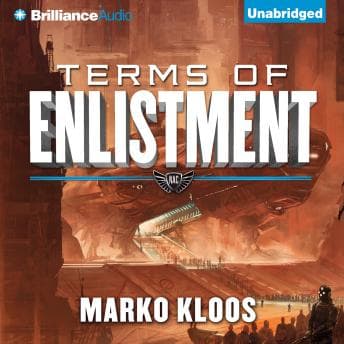

So last Tuesday I'm debugging a particularly nasty race condition at 11PM - the kind where two services are fighting over the same lock and neither will back down - and I need something to keep me from throwing my laptop off the balcony. I queue up Terms of Enlistment because Kevin's been bugging me about it for months, and honestly? I finished the whole thing before the fix deployed. Nine and a half hours. No regrets. Again.
TL;DR: Worth your commute. This is basically Starship Troopers but for people who actually want to see what the recruiting poster leaves out.
Boot Camp for Welfare Rats
Andrew Grayson lives in 2108's version of government housing, and Kloos doesn't sugarcoat it. The welfare tenements feel like someone took the worst public housing projects, scaled them to city-block size, and removed any pretense of upward mobility. Andrew's only two exits: win a colony lottery with worse odds than getting a staff engineer promotion in this economy, or enlist. He enlists.
The boot camp section is where Kloos really earns his stripes (pun intended, fight me). You can tell the guy served - the military bureaucracy, the way drill instructors oscillate between terrifying and weirdly paternal, the obsessive detail about food quality going from "welfare rat soy patties" to actual protein. Andrew's fixation on real food is this small, specific detail that tells you everything about the world without a single info dump. That's efficient worldbuilding. I respect efficient code and I respect efficient worldbuilding.
But here's what surprised me: the book basically has two acts with very different energy. Boot camp and initial deployment feel like one story - ground-level, gritty, Andrew learning to be a soldier and dealing with putting down civilian riots in the same tenements he grew up in. Then the back half pivots hard into deep space and introduces an alien threat that's operating on a completely different scale. The destruction of a colonized world hits different when you've spent hours watching Andrew fight through the mundane ugliness of military life first. It's like - okay, you thought the hard part was surviving boot camp? Cute.
Luke Daniels Is Not Ray Porter, But He's Close
Look, I have a known bias. Ray Porter is my narrator. But Luke Daniels on this book? He's running a really solid process. Same reason I keep coming back to him for Trapped - the guy just understands pacing, no matter the genre. His Andrew Grayson voice has this flat, slightly detached quality that works perfectly for a kid from the tenements who's learned not to show too much. When Andrew's narrating action sequences - especially the battle scenes - Daniels keeps the pacing tight without going breathless. You know how some narrators treat combat scenes like they're calling a horse race? Daniels doesn't do that. He stays in Andrew's headspace, which means the fear comes through as controlled tension rather than panic.
The character differentiation is good, not great. His drill instructors sound appropriately terrifying, and he gives the female lead a voice that's distinct without being cartoonish. But some of the secondary military characters blend together a bit - when you've got multiple sergeants and officers barking orders, it can get muddy. At 6AM on the Caltrain, I occasionally lost track of who was talking in group scenes. Minor complaint, but worth noting.
No sound effects, no music, just clean single-narrator production. Which is fine. This book doesn't need the bells and whistles.
The Structural Bug Nobody Wants to Talk About
Okay so here's my one real gripe, and it's a book problem, not an audio problem. The two-act structure I mentioned? It almost feels like two novellas stitched together. The tonal shift from "gritty near-future military police action" to "holy crap there are aliens destroying entire planets" is... jarring. Not bad, exactly, but if you're expecting a clean three-act arc, this isn't it. It's more like a setup book - the first commit in what's clearly going to be a long feature branch. The Frontlines series is like 8 books deep now, and you can feel Kloos laying groundwork. I pushed through Fields of Fire right after this one, and the payoff for all that setup is real - the series gets better the deeper you commit.
That said, at under 10 hours, the ROI on this audiobook is solid. It doesn't overstay its welcome. Could some business books learn from this? (Yes. Every single one of them.)
Who Gets Deployed and Who Gets Discharged
Perfect for: train, gym, doing dishes while pretending you don't have Jira tickets to update. If you liked The Bobiverse for the everyman-in-extraordinary-circumstances vibe, or Old Man's War for the military sci-fi structure, you'll dig this. It's accessible mil-SF that doesn't require a degree in theoretical physics to follow at 1.5x speed.
Skip if: you want deep character studies or literary prose. Andrew is likeable but he's not complex. This is plot-driven, action-forward sci-fi. And if you need your series to have a satisfying standalone ending - this one's clearly Chapter 1 of a much bigger story.
Pushing to Production
I finished this in 2 commutes and one late-night debug session. It's not going to change your life, but it's exactly what it promises to be: solid military sci-fi with clean narration and enough worldbuilding to make you want book two. I already have Lines of Departure queued up. Kevin is insufferably smug about this.
And if Kloos hooks you the way he hooked me, Angles of Attack is where the series really starts swinging for the fences.