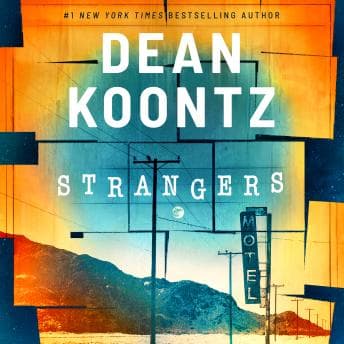

Look, I need to talk about Dick Hill's female voices. I need to get this out of my system before I can discuss anything else about this nearly thirty-hour audiobook. Every woman in Strangers — every single one — sounds like a man doing a bit at a comedy club in 1987. It's not just bad. It's distracting in a way that actively undermines scenes that should be genuinely unsettling. When Koontz is building toward something eerie, something that should crawl under your skin, and then a female character opens her mouth and sounds like your uncle doing an impression at Thanksgiving dinner? The dread evaporates. Gone. Poof.
I'm mad about it because the book doesn't deserve it.
Seven Strangers, One Shared Nightmare, and Way Too Many Pages
Here's the thing about Strangers that my librarian brain appreciates: Koontz wrote this in 1986 and he was already doing the "disparate characters connected by a mysterious event" structure that half the prestige horror of the last decade thinks it invented. A writer sleepwalking toward his closet every night, barricading himself inside. A doctor developing a crippling fear of the dark — not a vague unease, a full physiological terror response. A priest losing his faith not through intellectual doubt but through something that feels almost biological, almost imposed. A little girl in Las Vegas performing what looks like telekinesis. These threads are individually creepy in exactly the way I want horror to be creepy: rooted in the body, in involuntary responses, in the feeling that your own mind has been compromised.
Shirley Jackson walked so this particular brand of psychological violation could run. Koontz isn't Jackson — let's be clear about that — but he understood something she pioneered: the horror of not being able to trust yourself.
The problem is the architecture. At nearly thirty hours, this book sprawls. Koontz introduces you to each character with the thoroughness of a novelist who's being paid by the word (he probably was), and while the early sections — the individual nightmares, the escalating phobias — are genuinely unsettling, the middle third sags under the weight of its own ambition. By the time everyone converges on the Nevada desert, you've been through stretches where Koontz explains motivations that were already clear, describes settings in exhaustive detail, and gives you backstory that could've been trimmed by half. I was shelving returns at the library during one of these stretches and realized I'd zoned out for a solid fifteen minutes without missing anything critical. That's not great.
But when it works? It works. The concept of a shared suppressed memory — something done to these people that was then erased — taps into a paranoia that feels uncomfortably relevant. Government cover-up, memory manipulation, the sense that the authorities have already decided what you're allowed to know about your own life. Koontz was playing with ideas that feel more loaded now than they probably did in '86. The ensemble-of-strangers-pulled-into-something-bigger structure keeps showing up in mystery and thriller audiobooks too — I noticed it again recently in Bullet That Missed: A Thursday Murder Club Mystery, though that one earns its sprawl with considerably more charm and a narrator who actually differentiates her characters.
Dick Hill: Tension Builder, Character Destroyer
Here's where I'm genuinely torn. Dick Hill's baseline narration — his default male voice, his pacing during the thriller sequences, his ability to let silence sit — is actually pretty solid. He's a low talker, which I discovered the hard way when I tried listening while making dinner and couldn't hear him over the sound of onions sizzling. This is not a background audiobook. Not even close. You need headphones or a quiet room, which honestly fits the material. Horror should demand your attention.
He builds tension well. During the sleepwalking sequences, during the slow reveal of what happened at the motel, he knows how to let his voice drop, how to slow down just enough that your brain starts filling in the gaps. The narrator commits — partially. And that partial commitment is what makes the failures so frustrating.
Because every character sounds roughly the same. The writer, the doctor, the priest, the ex-military man — they're all filtered through the same gravelly register with minor variations that don't stick. Somebody compared him to George Costanza's dad from Seinfeld. I can't unhear it. And the women — I already ranted, but it bears repeating — sound absurd. Not just unconvincing. Absurd. In a book that asks you to take these characters seriously, that asks you to fear for them, the narration turns female dialogue into something you have to actively work past.
I listened in the dark. Mistake? Maybe. Worth it? For the first third, absolutely. For the rest, the darkness just made me more aware of how long I'd been sitting there.
Who Gets the Most Out of This (and Who Walks Away)
If you're a Koontz completist, you probably already own this. If you're new to Koontz and want to understand why he sold 450 million books, this is actually a decent entry point — it showcases both his strengths (paranoia, body horror that isn't about gore, ensemble plotting) and his weaknesses (overwriting, pacing issues, an ending that doesn't quite earn its runtime). If you scare easily, the early chapters will get you. If you don't, the ideas will still stick even when the execution wobbles.
But if female character voices in audiobooks are a dealbreaker for you — and honestly, they should matter more than most people admit — this performance will test your patience.
Shelve It Under: Flawed but Haunted
My podcast listeners are going to love arguing about this one. Strangers is a book that understands something fundamental about horror — that the scariest thing isn't what's in the dark, it's discovering that someone else has already been inside your head and rearranged the furniture. Koontz gets that. He just takes about ten hours too long to get there, and the audiobook performance is a mixed bag that ranges from genuinely tense to unintentionally comedic. I'm giving it credit for the concept and the best stretches of narration, but I can't pretend the lows aren't real.
Shirley (my cat) was unimpressed. I was mostly just exhausted. But the sleepwalking-toward-the-closet image? That's living in my head rent-free, and I suspect it will for a while.