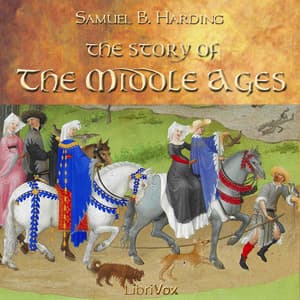

"The monks of the Middle Ages were the best educated people of their time," Kara Shallenberg reads somewhere around hour two, and I'm sitting in my car in the garage thinking about how my seven-year-old asked me yesterday what a knight actually *does* all day. This book? It answers that. And about forty other questions I didn't know I needed answered.
Look, I grabbed this audiobook because Emma's class is doing a medieval unit and I wanted to sound like I knew what I was talking about at homework time. Five and a half hours later, I'm genuinely invested in Charlemagne's family drama and the logistics of castle defense. This was not the plan.
When 1906 Meets 2024 Mom Brain
Here's what I didn't expect: a book written in 1906 for kids would actually be *perfect* for my fragmented attention span. Samuel B. Harding wrote this thing in these lovely, digestible chunks—the rise of the Christian church, then feudalism, then the Crusades—and each topic wraps up neatly before moving on. I paused this thing approximately 847 times (Sophie's nap was a lie that day, Lucas needed a snack, Emma couldn't find her shoes), and every single time I came back, I knew exactly where I was.
The language is old-fashioned, sure. Harding uses "youthful audience" phrasing that sometimes feels like your grandpa explaining history over Sunday dinner. But honestly? That's kind of charming. It's not dumbed down, it's just... clear. He explains why feudalism made sense to people living it, not just what it was. He connects the Hundred Years' War to stuff that matters. My brain, which has been running on three hours of sleep and cold coffee, could actually follow along.
Kara Shallenberg: The Unsung Hero of LibriVox
This is a volunteer narration, which—let's be real—can go either way. But Kara Shallenberg is genuinely good. Her American accent is crystal clear, her pacing is steady without being boring, and she reads like she actually cares about what she's saying. No weird pronunciation stumbles on the medieval names (and there are A LOT of medieval names). No dramatic pauses that make you think your phone died.
Is it a performance that'll win awards? No. There's no character differentiation because there aren't really characters—this is straight history. But for what it is, it works beautifully. I listened at my usual 1.25x and it held up perfectly. Actually made the 5.5 hours feel manageable.
The production is bare bones—no music, no sound effects, just Kara and the text. For a kids' history book, that's fine. My kids don't need dramatic sword-clashing sounds to understand what a siege was. (Though Lucas would probably disagree.)
Actually Useful for Homework Help
Here's where this gets practical: I can now explain to Emma what peasants ate, why castles had moats, and what the Crusades were about in age-appropriate terms. The book covers daily life stuff—what nobles did, what clergy did, what regular people did—in ways that translate directly to "Mom, what's a serf?" conversations.
Is it comprehensive? No. Is it going to satisfy history buffs who want nuance about the Byzantine Empire? Absolutely not. But for a mom who needs to sound competent during a second-grade project? Perfect.
The book does have that 1906 perspective, which means some of the framing around Christianity and European civilization is... dated. Not offensive, just very much of its time. Worth noting if you're sensitive to that, but it didn't bother me enough to stop listening.
Who Should Hit Play (And Who Should Keep Scrolling)
This is ideal for: parents helping with school projects, adults who want a basic refresher on medieval history without committing to a 40-hour epic, anyone learning English who wants clear historical content (one reviewer specifically mentioned it was great for non-native speakers), and homeschool families looking for supplemental material.
Skip it if: you want dramatic storytelling, you need modern historical analysis, or you're looking for something to keep your kids entertained on a road trip. This is educational content, not entertainment. My kids would be bored senseless. *I* found it interesting, but I'm also a grown woman who gets excited about understanding why the feudal system collapsed.
The Garage Sitting Verdict
I finished this during a combination of school drop-offs, one miraculous two-hour nap, and yes, my sacred garage sitting time. It made me feel smarter without requiring me to take notes. It survived constant interruptions. And now I can help with Emma's medieval project without frantically Googling at 9 PM.
Not groundbreaking, but sometimes you don't need groundbreaking. Sometimes you need something wildly different—like the unsettling atmosphere in Strange Case of Jekyll and Hyde (Version 4 - Dramatic Reading), which gave me a completely different kind of escape during naptime. And sometimes you just need a clear, calm voice explaining history while you pretend you can't hear your toddler calling your name from inside the house.
Worth the listen? If you need it, absolutely. It's free on LibriVox, it's well-narrated, and it does exactly what it promises. That's more than I can say for most things in my life right now.