
What makes someone worth naming a street after?
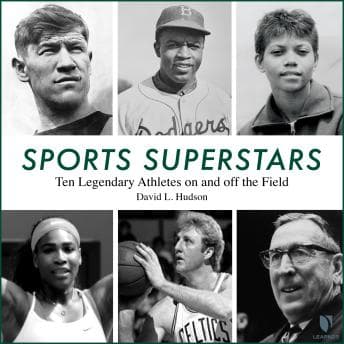
I was waiting in a client's lobby in downtown Austin - one of those corporate waiting rooms where they've got a TV on mute showing ESPN highlights nobody's watching - and I had about forty-five minutes to kill before a site assessment. Perfect window for a couple chapters of this. David Hudson's Sports Superstars isn't a thriller or a history of warfare, but here's the thing: half these athletes fought battles that mattered just as much as anything I saw downrange. Different terrain. Same guts.
Ten Profiles, Not Ten Puff Pieces
Let me cut to the chase - this is a lecture series, not a traditional audiobook. Twelve lectures covering ten athletes, and Hudson's a professor who also happens to be a championship boxing judge. That combination matters. When he gets to Muhammad Ali, he's not just reciting the "I shook up the world" greatest hits. He digs into the legal fight - Ali refusing induction, being stripped of his title at his absolute physical peak, and the Supreme Court case that followed. Hudson walks through the actual legal reasoning in Clay v. United States, the 8-0 decision. That's the kind of detail that separates someone who knows their subject from someone who watched a documentary once.
Jim Thorpe's section hit me harder than I expected. Most people know Thorpe won Olympic gold. Fewer know the IOC stripped his medals because he'd played semi-pro baseball for pocket money - we're talking maybe $15 a week. Hudson lays out how the amateur rules were selectively enforced against a Native American athlete while white athletes doing the same thing got a pass. The medals weren't restored until 1983, thirty years after Thorpe died. That's not sports trivia. That's an injustice with a timeline. The kind of institutional betrayal Hudson describes here — where the system works exactly as designed against the wrong person — reminds me of what Ben Macintyre unpacks in Spy and the Traitor, where decades pass before the full weight of a wrong gets acknowledged.
Wilma Rudolph's story is the one I'd recommend to anyone raising kids. Childhood polio, leg braces, told she wouldn't walk normally - then she becomes the fastest woman on the planet. Hudson doesn't sentimentalize it. He presents the facts and lets the facts do the heavy lifting, which I respect.
The Professor at the Mic
Hudson narrates his own material, and you can tell he's more comfortable behind a lectern than in a recording booth. His delivery is straightforward - appropriate inflection when the moment calls for it, steady pacing otherwise. He's not trying to be dramatic. He's teaching. If you've sat through Army War College lectures, this will feel familiar. Competent, organized, occasionally dry.
Is it electrifying narration? No. But I'd rather have an author who knows his subject cold than a professional voice actor reading words he doesn't fully understand. When Hudson talks about boxing - Ali's combinations, the scoring, the ring strategy - you can hear the difference. That's his wheelhouse, and the energy picks up.
At 4 hours and 45 minutes, this is a lean listen. No filler. Each athlete gets roughly 25-30 minutes, which is enough to cover the key moments without dragging. I knocked it out across two days of short drives and that lobby wait. At 1.25x it moves right along.
Where It Left Me Wanting More
This is where it lost me a bit - the format keeps things surface-level by necessity. With only half an hour per athlete, you're getting the highlight reel of their lives, not the full documentary. I wanted more on the political dimensions. Ali's story intersects with Vietnam, civil rights, religious freedom - any one of those threads deserves an hour. Thorpe's story is about institutional racism in early 20th century America. Hudson acknowledges these contexts but can't fully explore them in the time allotted.
And "ten legendary athletes" with twelve lectures means two of those lectures are doing setup and wrap-up work. Fine for a course format, but if you're coming in expecting wall-to-wall athlete profiles, adjust your expectations.
Who Should Lace Up for This One
If you want deep-dive biographies, this isn't it - go find individual books on these athletes. But if you want a solid survey course that gives you the essential stories of ten people who changed sports and, in several cases, changed their countries? Worth your time. It's particularly good for someone who knows sports but hasn't thought much about the off-field fights these athletes waged. The courage wasn't just physical.
Parents looking for something to listen to with older kids on a road trip - this works. Clean, educational, genuinely inspiring without being saccharine.
Mission Debrief
Ranger slept through most of this one, which I take as a sign it's calm and measured rather than pulse-pounding. Fair enough. Not every book needs to be a firefight. Sometimes you just need someone who knows their stuff to remind you that the people we put on pedestals usually earned it the hard way - through sacrifice most fans never think about. Hudson delivers that. Quietly, competently, and with real knowledge behind the words.






![Steve Jobs [unabridged audiobook] audiobook cover](/_next/image?url=https%3A%2F%2Fcovers.audiobooks.com%2Fimages%2Fcovers%2Ffull%2F9788499923406.jpg&w=1920&q=75)