
Ever stopped to think about who actually draws the line between your privacy and a police search warrant?
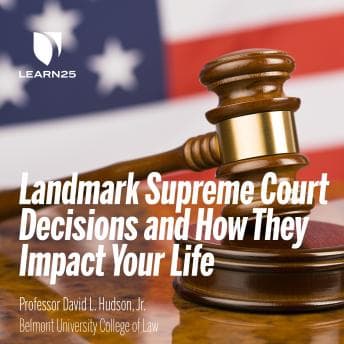
I do. Running a security firm in Austin, the legal side of things is usually a headache I pay someone else to handle. But knowing the rules of engagement—whether on a battlefield or in a courtroom—is survival 101. So, I picked up Landmark Supreme Court Decisions during a particularly long stakeout (don't ask). I figured a refresher on the Constitution wouldn't hurt.
Let me cut to the chase: this isn't a thriller. Nothing explodes. Nobody gets shot. But the stakes? They're higher than most of the fiction I listen to.
The Boxing Judge in the Classroom
Here's a detail that caught me off guard—the author and narrator, David Hudson, isn't just a law professor. He's a professional boxing judge.
Naturally, I expected the delivery to have some punch. Maybe a little aggression.
Whatever I was expecting, this wasn't it. Hudson narrates this like he's trying not to wake a sleeping baby. It's measured. Very measured.
(My German Shepherd, Ranger, was out cold within ten minutes of the first chapter. He usually stays alert for the Tom Clancy stuff.)
But here's the thing—once I got past the monotone delivery, I realized the guy knows his stuff cold. It's like listening to a really solid briefing officer. The kind who doesn't need to shout because the intel speaks for itself. He's not performing; he's teaching. And frankly, sometimes you just need the facts without the theatrics.
When the Intel is Good, the Delivery Matters Less
The content is where this book earns its stripes. Hudson covers 16 major cases—Brown v. Board, Roe v. Wade, Marbury v. Madison. You know the names, but do you know the people?
I didn't. Not really.
Hudson does a solid job of digging into the human element. He explains why these people sued, what was happening in the country at the time, and how the gavel dropping changed the landscape for the rest of us. History isn't just dates; it's usually one person getting pushed too far and deciding to push back.
That same sense of one person against impossible odds hit me hard in Three Day Road—different battlefield, same kind of grit.
I appreciated the breakdown of the legal logic. It's clean. No jargon just to sound smart. He explains it so a grunt could understand it, which I appreciate.
Who This Brief Is For (And Who Should Stand Down)
If you want to actually understand why the Supreme Court matters—especially with how crazy politics are these days—this is worth the credit. Good fit for anyone who needs the constitutional basics without law school debt. Skip it if you need dramatic narration to stay engaged; Hudson's delivery is strictly informational.
Mission Debrief
Look, this is a lecture series disguised as an audiobook. If you go in expecting a dramatic reenactment of A Few Good Men, you're going to be disappointed. It's dry.
But it's dense, it's informative, and it's short enough to finish in a couple of gym sessions or a drive from Austin to Dallas.
Just do yourself a favor: crank the speed up. I listened at 1.35x, and it flowed a lot better. At 1.0x, you might join Ranger for a nap.




![Steve Jobs [unabridged audiobook] audiobook cover](/_next/image?url=https%3A%2F%2Fcovers.audiobooks.com%2Fimages%2Fcovers%2Ffull%2F9788499923406.jpg&w=1920&q=75)