
I teach high school English in Chicago. Twenty years of watching teenagers pretend they've read The Great Gatsby. So when I say a book about World War I snipers made me miss my stop on the Red Line—twice—you know something's working.
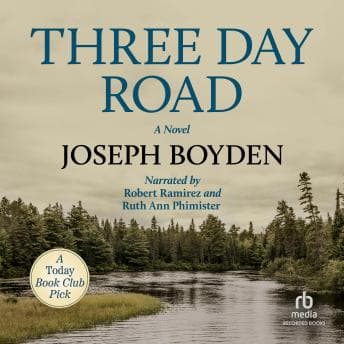
Three Day Road isn't the kind of war novel I expected. It's quieter. More devastating for it. Joseph Boyden structures this thing like a canoe trip through memory—Xavier Bird, a Cree sniper returning from the trenches, addicted to morphine and missing a leg, travels home with his aunt Niska while the past bleeds into the present. And I mean bleeds. The timeline shifts between the horrors of France and the wilderness of northern Ontario, between two young men who entered the war as brothers and emerged as something else entirely.
The Voice That Carries You Through
Robert Ramirez narrates Xavier's sections, and look—I've listened to a lot of audiobooks. A lot. Ramirez does something I rarely hear: he trusts the silence. His delivery is stoic in the best sense. Not emotionless. Restrained. Like a man who's seen too much to speak loudly about it. When Xavier describes watching through his rifle scope, waiting for the moment to take a life, Ramirez doesn't dramatize it. He just... tells you. And that restraint makes it unbearable in exactly the right way.
Ruth Ann Phimister handles Niska's chapters—Xavier's aunt, a Cree woman with her own history of loss and survival. She brings warmth where Ramirez brings stone. Her voice feels like sitting by a fire while someone tells you the stories they've never told anyone else. The contrast works. It's supposed to feel like two different worlds, because it is.
Now, some listeners have complained about the narrator switches being confusing. I get it. The first hour or so requires attention. You're learning the rhythm—whose voice means which timeline, which character. But honestly? If you're listening while half-distracted, this isn't the book for you anyway. This one demands presence. (My students would say I'm being pretentious. They're probably right. I don't care.)
Where the Narrative Shifts Hit Hardest
Boyden does something Faulkner would appreciate—he makes you work for the story. The past and present aren't separated cleanly. They bleed together the way trauma actually works. Xavier's morphine haze mirrors the fog of memory, and the audiobook format makes this disorientation physical. You're in the canoe. You're in the trench. You're not always sure which.
The Cree language appears throughout, and both narrators handle it with care. Some listeners mentioned the polysyllabic words caused pauses in flow. For me, those pauses were part of the point. These aren't decorative words—they're the language Xavier and Elijah grew up speaking, the language the residential schools tried to beat out of them. Hearing them spoken, even imperfectly, felt like an act of recovery.
Elijah Whiskeyjack is the character who'll haunt you. He and Xavier enter the war as equals, but Elijah becomes something else. He discovers he's good at killing. Too good. He starts to enjoy it. The novel tracks his transformation with the patience of watching ice crack—you know what's coming, but you can't look away. Ramirez voices both characters, and the way he shifts Elijah's energy as the war progresses is subtle and devastating.
The Gut-Punch Moments
I won't spoil specifics, but there's a scene late in the book—Xavier making a choice that defines everything—that made me stop walking on the lakefront. Lolita did that to me once too—a different kind of moral devastation, but the same physical reaction to a narrator making you complicit in something unbearable. Just stood there. Denise asked if I was okay. I wasn't, really. That's the kind of book this is.
The violence is graphic but never gratuitous. Boyden writes war the way I imagine it actually felt—long stretches of boredom and cold punctuated by moments of absolute horror. The audiobook pacing reflects this. It's slow in places. Deliberately. If you're the type who listens at 2x speed, you're going to miss the point entirely. This is a 1.0x book. Maybe 1.1x if you're feeling impatient. The pauses are punctuation.
Would I Assign This to My Students?
Probably not. Too much morphine addiction, too much violence, too many parents who'd email me. But I'd recommend it to the ones who stay after class asking about books that actually matter. The ones who want to understand something about Canada's Indigenous history, about what war does to the people who survive it, about friendship that curdles into something unrecognizable.
Who Should Listen (And Who Should Skip)
If you want a war novel that sits with you—one that cares as much about what soldiers carry home as what they did in the trenches—this is yours. Listeners interested in Indigenous Canadian history or the psychological toll of combat will find this especially rewarding. But if you need fast pacing or a single linear timeline, skip it. This book punishes impatience.
At fifteen hours, it's a commitment. I finished it over two weeks of grading papers and pretending to listen to faculty meetings. (Principal Martinez, if you're reading this—I definitely heard your budget presentation. I did not.) But the length feels earned. You need time to sit with these characters. To understand what they've lost.
This isn't a book that makes war look noble. It doesn't make survival look heroic. It just shows you what happened, and lets you carry it the way Xavier carries it—heavy, and forever.