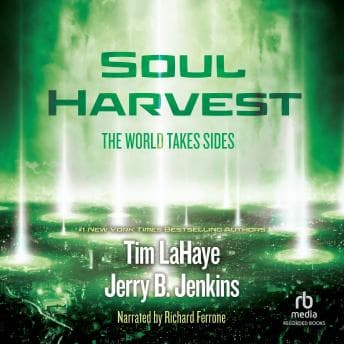

"The Tribulation Force has seen much despair and death."
I hit pause somewhere around the three-hour mark and just sat there in my car, engine off, staring at the lake. Not because the prose demanded contemplation in the way Faulkner does. But because I needed to process what I was actually listening to.
Look, here's the thing. I came to the Left Behind series late—decades late, really. My students keep referencing it in papers about apocalyptic literature, and I figured it was time to understand what 65 million readers saw in these books. Soul Harvest is book four, which means I've now spent roughly 40 hours in this particular vision of the end times. That's more time than I spent on my dissertation proposal. (Don't tell my advisor.)
Where Faith Meets Genre Fiction
Tim LaHaye and Jerry B. Jenkins are doing something interesting here, even if it's not what I'd call literary. They've taken dispensationalist theology—a very specific interpretation of Revelation—and wrapped it in the trappings of a Tom Clancy thriller. Pilot Rayford Steele works for the Antichrist. Journalist Buck Williams searches earthquake rubble for his wife. The Tribulation Force operates as a kind of spiritual resistance cell.
The earthquake that opens this book? Massive. Global devastation, millions dead, civilization crumbling. And yet the narrative focuses less on the physical horror than on the spiritual stakes. Every character interaction becomes a potential conversion moment. Every crisis an opportunity for faith.
This is where I think some readers bounce off. The dialogue can feel—how do I put this gently—like it's doing homework. Characters explain theology to each other in ways that real people wouldn't. But I've taught enough high school to recognize what's happening. This is didactic fiction. It's not trying to be Cormac McCarthy. It's trying to be accessible, clear, and spiritually instructive.
And honestly? For what it's attempting, it works.
Richard Ferrone Carries the Weight
Now here's where the audiobook earns its keep. Richard Ferrone has a voice built for this material—authoritative without being preachy, dramatic without tipping into melodrama. He differentiates characters clearly, which matters when you've got a sprawling cast of believers, skeptics, and one very charismatic Antichrist.
The Nicolae scenes are particularly effective. Ferrone gives him this smooth, reasonable quality that makes you understand why people follow him. It's unsettling in exactly the right way. When he shifts to Rayford's internal conflict—a man serving evil while secretly working against it—you feel the tension.
I listened at 1.0x, as always, because the pacing here matters. There are moments of genuine emotional weight, especially in Buck's desperate search for Chloe. Ferrone doesn't rush these. He lets the uncertainty breathe.
One caveat: I've heard complaints about the abridged version having awkward gaps and interval music that disrupts the flow. I can't speak to that directly, but if you're choosing between versions, go unabridged. Always go unabridged. (My students think this is my most annoying opinion. They're probably right.)
The Harvest Metaphor
The title refers to a concept from Matthew 9—the idea that in the last days, there will be a great gathering of souls to faith. It's hopeful, actually, in a way the series doesn't always get credit for. Yes, there's tribulation. Yes, there's an Antichrist consolidating power. But the authors keep returning to this idea that it's never too late. That grace remains available even as the world burns.
This is the theological heart of the series, and Soul Harvest leans into it harder than the previous books. The earthquake isn't just disaster—it's catalyst. Characters who were on the fence make choices. The stakes feel genuinely spiritual, not just physical.
Do I agree with the theology? That's not really the question. I teach Milton to teenagers who don't believe in his God either. What matters is whether the authors commit to their vision. They do. Completely.
Who Should Listen (And Who Should Skip)
If you're already invested in the series, this is where things get interesting. The global scope expands. The spiritual warfare intensifies. Ferrone's narration elevates material that could easily feel preachy into something genuinely engaging.
If you're coming in cold—don't. Start with book one. The premise requires setup.
And if you're hostile to evangelical Christianity, this probably isn't your apocalypse. There are other end-of-the-world narratives that might suit you better. The Road exists. Station Eleven exists. Hell, even Where the Crawdads Sing has its own kind of spiritual reckoning woven through the survival story. This one is specifically, unapologetically Christian.
Class Dismissed
Here's what I'll say. As someone who spends his life teaching literature, I've learned that books can matter for reasons beyond craft. Sixty-five million readers found something in these pages. Something about hope in darkness, about faith under pressure, about choosing sides when the world demands a choice.
That's worth understanding, even if you're not in the choir.
I finished the last chapter walking the lakefront with Denise. She asked what I was listening to. I tried to explain dispensationalist eschatology in a way that wouldn't make her eyes glaze over. I failed. But I'm still thinking about it, which is more than I can say for most faculty meetings.