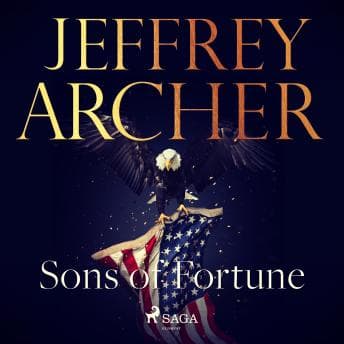

I was making pancit at 6 AM - post-shift cooking therapy, the kind where your hands know the recipe but your brain is still buzzing from a rough night in the trauma bay. Carlos and the kids were still asleep, and I had Michael Brandon's voice in my earbuds telling me about twin boys separated at birth. Sixteen hours of audiobook is a commitment. This one tested that commitment more than I expected.
Jeffrey Archer does something here that I genuinely appreciate on paper: he builds two parallel lives with the patience of a surgeon doing microsurgery. Nat Cartwright, the middle-class kid who becomes a Vietnam War hero and Republican politician. Fletcher Davenport, raised by the millionaire family, Yale-educated defense attorney turned Democrat. Their lives mirror and diverge and almost touch, over and over, for decades. It's the kind of structure that rewards patience - and Archer clearly loves the long game. The switched-at-birth setup courtesy of a desperate nurse covering up a cot death is pure Archer melodrama, and honestly? I'm not mad at it. That's why you pick up a Jeffrey Archer novel. The same melodrama-as-feature-not-a-bug energy pulled me through Cater Street Hangman too — sometimes you just want a story that commits fully to its own theatrical instincts.
Two Lives, One Voice, Zero Distinction
Here's where the audiobook version hurts itself. Michael Brandon narrates both Nat and Fletcher - two men with completely different upbringings, different social classes, different political philosophies - in essentially the same voice. Same cadence, same tone, same energy. When the story sweeps between their timelines (which it does constantly), I found myself rewinding during my drive home more than once trying to figure out whose chapter I was in. As someone who spends twelve-hour shifts distinguishing between doctors barking orders in a trauma room, I have a pretty good ear for vocal differentiation. Brandon gives me nothing to work with.
And look, Brandon has a theater background - Broadway, West End, he played Jerry Springer in an opera for crying out loud. The man has range. But he doesn't use it here. Every character sounds like the same well-spoken middle-aged man having a reasonable conversation. When Nat is supposed to be a working-class kid from a modest family and Fletcher is Ivy League money, those voices should feel different in your bones. They don't. I kept waiting for some tonal shift, an accent choice, anything - and it never came.
The Archer Formula: Predictable Like a 3 AM Blood Draw
I'll say this about the story itself: if you've read Kane and Abel, you know exactly what you're getting. Archer loves his separated-by-fate dual protagonists, the political chess games, the decades-long family sagas where every coincidence feels engineered by God with a flair for dramatic irony. Sons of Fortune follows that formula faithfully. Maybe too faithfully.
The Vietnam War sections had some weight to them. Nat's arc from soldier to politician felt like the meatier half of the book - there's real tension in his story, real stakes. Fletcher's legal career, by contrast, felt like it was running on autopilot for long stretches. Courtroom scenes that should've crackled just... didn't. And the big convergence point - one twin defending the other for murder - arrives so late and resolves so neatly that I wanted to throw my phone at the dashboard. (I didn't. I was in the driveway by then. But the intent was there.)
The political material is interesting enough if you enjoy watching how campaigns are run, how alliances form and fracture. Archer knows politics from the inside - the man was literally in Parliament - and that insider knowledge shows. But "interesting enough" across sixteen hours is a lot of hours to fill with interesting enough.
Who Gets the Earbuds
If you loved Kane and Abel and want more of the same structural DNA, you'll probably enjoy this. Archer fans know what they're signing up for, and he delivers on the family saga promise. But if you're coming in fresh, or if you need your audiobook narrator to do some heavy lifting with character voices - and at 16 hours, you absolutely need that - this production will frustrate you.
I'd honestly recommend this one in print over audio. The story itself is a solid 3.5, maybe even a light 4 for Archer devotees. But the narration drops it. When you can't tell your two protagonists apart by ear alone in a book built entirely on following two protagonists separately, that's a structural problem the audiobook format can't survive.
Shift Change: My Honest Prescription
Carlos asked me if I liked it when I finally finished it three shifts later. I told him it was like a patient with good vitals but no personality - technically everything's working, nothing's actually wrong, but you're not going to remember them next week. Night shift approved only if you've got nothing else in your queue and you need background during charting. Otherwise, grab the paperback. My mom would love this - she's a sucker for family sagas and twins and political drama. She still thinks I should've been a doctor, so she'd probably relate to the whole "ambitious family expectations" thing more than she'd admit.