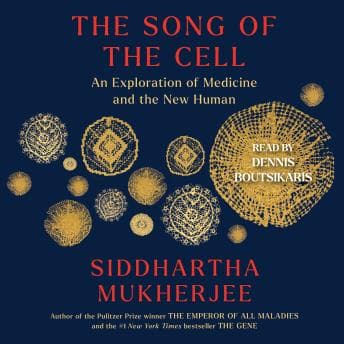

I'm going to be honest: I started this one on my 6:47 AM Caltrain thinking it would be perfect background for my half-conscious commute. By Millbrae, I realized I'd absorbed approximately nothing. Mukherjee doesn't do background listening. This is the distributed systems textbook of science audiobooks—you either give it your full attention or you're just hearing words.
Bottom Line: Worth your commute—but ONLY if you're actually awake and not multitasking. This is basically a graduate seminar in cellular biology disguised as narrative nonfiction.
The Density Problem (And Why It's Also the Point)
Let me save you the frustration I experienced: Song of the Cell is 16 hours of genuinely fascinating science that requires what I'd call "dedicated listening mode." I ended up finishing this during a week of insomnia after a particularly brutal on-call rotation—2 AM, couldn't sleep, might as well learn about T-cells and CAR-T therapy. And you know what? It worked. The material is dense, but Mukherjee writes like he's explaining it to a curious colleague, not dumbing it down.
The structure is clever—he traces the history of cellular discovery from Robert Hooke's 17th-century microscopes through to modern immunotherapy. There's this great section where he describes van Leeuwenhoek, this Dutch cloth merchant who basically invented microbiology as a hobby. The guy was grinding his own lenses and discovering bacteria while everyone else was just... selling fabric. It's the kind of origin story that makes you feel inadequate about your own side projects. Alexander Hamilton had that same effect on me—another overachiever making the rest of us look lazy.
Boutsikaris Knows What He's Doing
Dennis Boutsikaris narrated The Gene for Mukherjee too, and you can tell he's figured out the formula. He's got this thriller-narrator background, and he uses it—adding emphasis and dramatic tension in places where lesser narrators would just drone through the technical bits. When Mukherjee describes the first successful bone marrow transplant, Boutsikaris makes it feel like a heist movie climax. The man makes T-cell receptor signaling sound suspenseful. That's talent.
The ROI on this audiobook is high IF you're the right listener. If you want science that's accessible but doesn't insult your intelligence, if you actually want to understand why CAR-T therapy is revolutionary (and terrifying), if you're the kind of person who reads the methods section of papers for fun—this is your book.
The Science Actually Holds Up
As someone who debugs systems for a living, I appreciated that Mukherjee treats the human body like what it is: a massively distributed system with trillions of autonomous agents. He makes the analogy explicit sometimes—cells as self-contained units, communicating through chemical signals, failing in cascades. The chapter on cancer basically describes it as a consensus failure. Rogue cells that stop responding to the system's shutdown commands. (If you've ever dealt with a runaway process that ignores SIGTERM, you'll feel a kinship.)
But here's the thing—some parts are tedious. I won't pretend otherwise. There are stretches where the technical detail is necessary for understanding but not exactly thrilling. The sections on hematopoietic stem cells are important, but I caught myself zoning out during the third explanation of differentiation pathways. Could've been a blog post? No, actually. This one earns its length. But it earns it the hard way.
Who's This Actually For?
Listen if: You loved The Emperor of All Maladies or The Gene. You're a biology nerd, med student, or engineer curious about how the meatware works. You find the phrase "cellular therapy" exciting rather than intimidating.
Skip if: You're a multitasker. You want light science writing. You need to absorb content while navigating rush hour traffic.
I finished this across maybe 10 sessions, mostly late nights and one very long weekend debugging session where I needed something to keep my brain from spiraling about production issues. It's not a packed-train book. It's not a gym book. It's a "sitting in a quiet room with a cup of tea" book, or a "3 AM insomnia" book.
System.exit(0)
Mukherjee has written another dense, rewarding, occasionally exhausting exploration of medicine. It's not as immediately gripping as Emperor of All Maladies—that book had the narrative urgency of cancer itself. This one is more encyclopedic, more foundational. It's the documentation you need to read before you can really understand the exciting stuff.
Boutsikaris delivers it with enough drama to keep you engaged, but he can't change the fact that some of this material is just... hard. That's not a criticism. The best science writing doesn't pretend complexity is simple. It just makes complexity comprehensible. Song of the Cell does that. It just asks you to meet it halfway.







![Steve Jobs [unabridged audiobook] audiobook cover](/_next/image?url=https%3A%2F%2Fcovers.audiobooks.com%2Fimages%2Fcovers%2Ffull%2F9788499923406.jpg&w=1920&q=75)