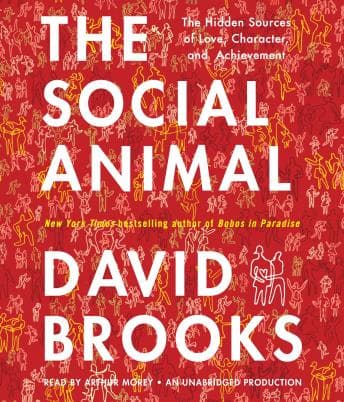

David Brooks wrote a 16-hour nonfiction book disguised as a novel, or maybe a novel disguised as a nonfiction book, and honestly I'm still not sure which one irritates me more.
Let me back up. I was deep into a post-on-call recovery week — you know, the kind where you've been paged so many times your phone vibrating gives you a Pavlovian stress response — and I wanted something brainy but not code-related. Something about humans and why we're all so weird. The Social Animal kept popping up in my Audible recommendations, and at 16 hours, it promised to eat my commute for a solid week and change. So I bit.
The Architecture Decision That Divides Everyone
Here's the pitch: instead of writing a straight pop-science book about psychology, neuroscience, and social behavior, Brooks creates two fictional characters — Harold and Erica — and threads decades of research through their life stories. Birth to death. Love, career, failure, success. It's basically Thinking, Fast and Slow but wrapped in a narrative framework, like if Kahneman had written a Lifetime movie to explain System 1 and System 2.
And look, I get what he was going for. The idea is that by watching Harold fall in love or Erica climb out of poverty, the research lands harder because you're emotionally invested. In practice? It's... uneven. The Harold-and-Erica storyline jumps from one life milestone to the next like a badly designed state machine — you get this intimate scene of a boy and girl falling in love, and then Brooks hits pause to dump three chapters of research on unconscious cognition and social norms, and then you're suddenly ten years later and Harold's in a completely different context. The transitions feel forced. It's like watching someone alt-tab between a novel and a textbook.
Some listeners absolutely hate this structure. I didn't hate it, but I caught myself wishing he'd just committed to one mode. Either give me the science straight (like Robert Sapolsky would) or actually develop these characters with the care they deserve. The hybrid approach means neither half reaches its potential.
Where the Science Actually Holds Up
Okay, but here's the thing — when Brooks is synthesizing research, he's genuinely good at it. The sections on how unconscious processing drives most of our decision-making, how attachment styles form in infancy and ripple through adult relationships, how social trust functions as economic infrastructure — this stuff is solid. He pulls from behavioral economics, evolutionary psychology, neuroscience, sociology, and somehow keeps it digestible without dumbing it down.
The core argument — that Western culture massively overweights rationalism and IQ while ignoring the emotional and social substrates that actually determine outcomes — is one I buy. As someone who works in systems design, the analogy writes itself: we spend all our time optimizing the application layer and ignore the network layer underneath. Brooks is basically saying human flourishing is a distributed system and we've been debugging the wrong service.
The ROI on this audiobook is highest if you're interested in why people succeed or fail in ways that standardized metrics don't capture. If you want actionable takeaways, though, you'll be disappointed. This is more "here's a framework for thinking about human nature" than "here are five steps to optimize your life." Which, honestly, is refreshing compared to the startup-bro books I usually speed through at 1.75x. The same contrast hit me with Jim Cramer's Get Rich Carefully, which leans so hard into the actionable-steps lane that it made me appreciate Brooks' restraint more in retrospect.
Arthur Morey Carries the Load
Arthur Morey's narration is the glue holding this thing together. His pacing — and I mean this specifically — manages the constant gear-shifting between fictional narrative and academic exposition without making you feel like you're getting whiplash. When Harold's storyline gets emotional, Morey adjusts his tone just enough to signal "we're in the story now" without going full dramatic audiobook voice. When Brooks pivots to citing studies, Morey's delivery gets slightly more measured, almost professorial. It's subtle work. His voice apparently resembles Brooks' own, and I can see that — there's this educated-but-approachable quality that fits the material perfectly.
I listened at 1.5x as usual and it worked fine. I wouldn't go faster. There's enough density in the science sections that 1.75x would've had me rewinding constantly, and at 6AM on the Caltrain, rewinding is a commitment I'm not willing to make.
Who Should Grab This (and Who Should Run)
Perfect for: long commutes, road trips. You need sustained attention but not laser focus — it's complex enough to keep your brain engaged but narrative enough that you won't lose the thread if someone bumps into you on a crowded train. Skip for: anyone wanting a tight, structured argument. This meanders. Intentionally, but still.
If you loved Behave by Sapolsky or Stumbling on Happiness by Gilbert, you'll find familiar territory here. If the phrase "let me illustrate this research finding with a fictional vignette" makes you twitch, trust that instinct.
The Commit Message
TL;DR: Worth your commute, but with caveats. Brooks is trying to do something ambitious — merge narrative fiction with pop-science synthesis — and it works about 70% of the time. The science is strong, the narrator is excellent, and the fictional framework is either the book's greatest strength or its most annoying quirk depending on your tolerance for being told a story when you came for the data. I finished it in about 5 commutes and I'm glad I listened, but I wouldn't re-listen. It's a 3.5 that earns its runtime mostly on Morey's delivery and the genuine breadth of research Brooks pulls together.