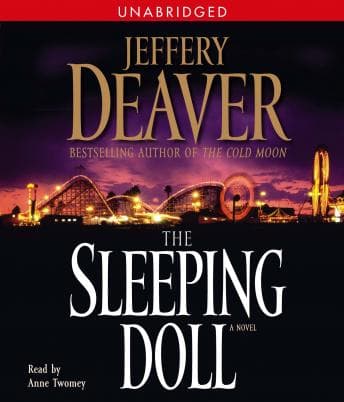

Jeffery Deaver wrote a 15-hour novel about a kinesics expert — a body language reader — and I have never felt more professionally seen and simultaneously attacked.
I was making dal makhani from scratch on a Sunday afternoon, the kind of slow-cook project where you're stirring every twenty minutes and need something absorbing enough to keep you from checking your phone. Sleeping Doll was perfect for that. Almost too perfect. Because every time I went to check the lentils, Kathryn Dance was reading someone's baseline behavior and I was standing frozen over the stove thinking, "Wait, she's right about the stress indicators but wrong about the motivation" — arguing with a fictional character like she was a colleague presenting at a conference. This is my life.
When Your Protagonist Is Basically a Walking DSM Case Study (Complimentary)
Kathryn Dance is a fascinating case study in what happens when you give a protagonist genuine professional competence instead of just telling us she's smart. Deaver clearly did his homework on kinesics and interrogation technique. Dance doesn't just "sense" things — she reads micro-expressions, catalogs deviation from baseline behavior, and builds psychological profiles in real time. The interrogation scenes with Daniel Pell are the heart of this book, and they're structured like chess matches. Dance probes. Pell deflects. Both of them know the other is playing a game, and both think they're winning.
What makes Pell compelling is that Deaver doesn't make him a cartoon sociopath. The protagonist exhibits classic cult leader patterns — selective empathy deployment, manufactured intimacy, the ability to make people feel chosen. The research actually shows that cult leaders rarely use overt coercion; they use belonging as a weapon. Deaver gets this right. Pell doesn't force his followers to do terrible things. He makes them want to. That distinction matters enormously, and it's where the book earns its psychological credibility.
But — and this is where my eyebrow went up — the plot starts piling twists on twists until the psychological precision that made the first half so sharp gets buried under Deaver's compulsive need to surprise you. I found myself asking: why does Pell really escape, and what is the actual endgame? The answer, when it comes, requires you to accept that this man planned seventeen moves ahead while improvising a prison break. Psychologically, this doesn't track. Cult leaders are adaptable, sure, but they're also deeply narcissistic — they don't execute military-grade tactical plans. They manipulate. The late-novel Pell feels like a different character than the interrogation-room Pell, and that bothered me.
The reunion scene with the three former cult women, though? That's where Deaver's instincts are sharpest. The way manipulation and complicity braid together in these dynamics is something I was also turning over while reading Confessions on the 7:45 — different genre register, but the same uncomfortable question about how much people choose their own entrapment. Three women, decades out, still performing the roles Pell assigned them — the caretaker, the rebel, the true believer. My therapist would have thoughts about every single one of these characters. The way trauma bonds calcify into identity is something most thriller writers handwave. Deaver leans into it.
Anne Twomey's Voice Is an Acquired Taste (I Acquired It)
Let me be honest: the first hour was rough. Anne Twomey has a mature, slightly scratchy quality that initially felt at odds with Dance, who I'd imagined as sharper-edged, more clipped. But somewhere around the second interrogation scene, it clicked. The deliberate pacing — which some listeners will find slow — actually mirrors the methodical way Dance processes information. Twomey doesn't rush through the kinesics analysis, and she shouldn't. This is a book where the tension lives in someone's eye twitch, not in a car chase.
She's not doing vocal fireworks. There's no dramatic range between characters that'll make you forget it's one narrator. But there's a steadiness to her performance that works for procedural tension — she builds suspense the way a pot builds to a simmer, not a boil. By the final sequence, where the plot threads converge and Pell's real purpose becomes clear, I'd stopped noticing the voice entirely. That's actually the highest compliment I can give a thriller narrator: she disappeared into the story.
At 15 hours and 43 minutes, this is a commitment. 1.25x speed is your friend here — it tightens the deliberate pacing without losing the interrogation nuance.
Who Gets the Most Out of This
If you loved The Bone Collector but wished Lincoln Rhyme had a colleague who understood behavioral psychology instead of just forensic evidence — this is your book. Dance and Rhyme occupy the same universe but different methodologies, and honestly? I prefer Dance's. Reading people is messier than reading crime scenes.
If you need your thrillers under 10 hours, or if Deaver's signature twist-upon-twist structure frustrates you (you know who you are), this will test your patience. The middle third sags under the weight of its own plot mechanics.
The Case File, Closed
Smart psychological foundation, slightly overstuffed execution, a narrator who earns her keep by the halfway mark. Deaver understands human nature better than most thriller writers — he just can't always resist being cleverer than his own characters. Worth the listen for the interrogation scenes alone. The dal turned out great, by the way.