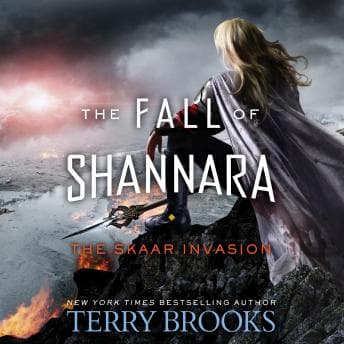

The Four Lands are at war with themselves before the Skaar even show up.
That realization hit me somewhere around hour six, walking the lakefront on a Saturday morning while Denise talked about her sister's wedding plans. I was nodding at appropriate intervals. I was not present. I was in Paranor, watching institutions crumble. (Denise, if you're reading this: the centerpiece idea sounds lovely.)
When the Old Master Reaches for Something New
Look, I've been reading Terry Brooks since before most of my students' parents were born. The original Sword of Shannara was derivative of Tolkien in ways that would get a student paper flagged for "insufficient originality"—and I loved every page of it anyway. So when people say Brooks is predictable, I need them to understand: that's partly the point. You come to Shannara the way you come to a favorite uncle's house. The furniture's in the same place. The stories follow familiar grooves.
But The Skaar Invasion does something I wasn't expecting from book two of a four-part farewell tour. It gets political. Not in a clumsy way—Brooks is too seasoned for that—but the Skaar as invaders who "reveal a more human face" while continuing their conquest? The Druids fractured and ineffective against a threat they can barely comprehend? The political maneuvering inside the invaded lands being almost as dangerous as the invaders themselves? This is Brooks writing about isolationism and institutional failure wearing a fantasy costume. The Tordotcom review called it "aggressively political" and that's right. My students would probably actually engage with this one, which is the highest praise I can offer.
The Tarsha and Tavo storyline—the siblings with the wishsong, one trying to control her gift, the other consumed by his—that's where the emotional weight lives. Their scenes carry a Greek tragedy inevitability that the larger military conflict can't quite match. You know where it's heading. You dread it anyway.
Simon Vance Trusts the Text
Simon Vance narrating fantasy is like having a Shakespearean actor read you bedtime stories. The man has won enough Earphones and Audie Awards to fill a shelf, and you can hear why. He keeps the narrative moving at Brooks's intended pace—brisk when the Skaar are on the march, slower and more deliberate when Drisker Arc is piecing together ancient knowledge inside vanished Paranor.
Here's what I appreciate most: Vance doesn't oversell the battle scenes. A lesser narrator would go full blockbuster trailer when the Troll armies fall. Vance holds back. He trusts the prose to do the heavy lifting and provides just enough vocal tension to keep your pulse up. The narrator understands that pause is punctuation—and he uses it.
That same restraint shines in High Druid's Blade: The Defenders of Shannara, another Shannara audiobook where Vance's understated approach lets the prose do the heavy lifting.At 1.0x—because the author chose those words and I choose to hear them properly—the pacing felt right for a twelve-and-a-half-hour middle chapter. That said, the character voices blur more than I'd like. Dar Leah and Drisker Arc could use more vocal separation. When you're juggling this many POV characters across a sprawling political plot, clarity matters, and there were moments in dialogue-heavy scenes where I had to rewind to catch who was speaking. Not a dealbreaker. But noticeable.
The Predictability Problem (And Why I'm Mostly Fine With It)
The most common criticism? "I can usually predict his plot twists." And yeah. The cliffhanger ending is visible from about three hours out if you've read any Brooks before. This isn't a George R.R. Martin situation where you genuinely fear for every character's survival. Brooks plays fair with his readers, sometimes to a fault.
But here's what I keep coming back to. This reminds me of what Hemingway said about prose being architecture—Brooks has been building this particular cathedral for forty years. Predictability in a series finale isn't the same sin as predictability in a standalone novel. The comfort of familiar patterns is part of the contract. I'm not here for shock value. I'm here for the farewell.
The real frustration is structural. This is book two of four, and it feels like book two of four. Setup, escalation, cliffhanger. The "forerunner of a much larger army" reveal is exactly the kind of middle-book promise that asks you to buy the next ticket before this ride has stopped.
Who Gets the Assignment
If you've been with Shannara from the beginning—or even since Heritage—this is required listening. Brooks is clearly building toward something, and the political sharpness here suggests the final two books might have real teeth.
New to Shannara? Don't start here. Go back to The Black Elfstone at minimum, or go all the way to the beginning. This book assumes you know these lands, these institutions, these types of magic. It doesn't hold your hand. It shouldn't.
If you need your fantasy to surprise you on every page? Probably not your book. Brooks writes comfort food for the genre-literate, and The Skaar Invasion is a good version of that—but it is still that.
Pencils Down, Books Open
The prose deserves to be savored, even when the destination feels mapped out. Simon Vance makes sure you don't rush past the good parts. Worth pausing the faculty meeting for—but maybe wait for a sale unless you're already committed to seeing Shannara through to the end. Forty years of world-building earns Brooks the right to a slow goodbye. Whether that patience rewards you depends on how long you've been walking these lands alongside him.