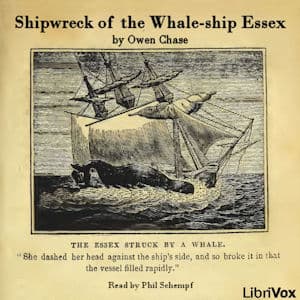

I was up at 0430 — old habits die hard — sitting on the back porch with Ranger and a black coffee, watching the sun come up over Austin. Couldn't sleep. Figured I'd knock out something short from the queue, and this one had been sitting there for weeks. Two and a half hours later, the coffee was cold and I hadn't moved.
Let me cut to the chase: this is the real story behind Moby-Dick. Not a novel. Not a dramatization. The actual first-person account from Owen Chase, First Mate of the Essex, written in 1821, less than a year after an 80-ton sperm whale deliberately rammed and sank his ship in the middle of the Pacific Ocean. If that premise doesn't grab you, check your pulse.
A Whale Chose Violence and Won
Here's what got me. Chase describes the whale's attack with this eerie, almost clinical precision that only comes from someone who actually lived it. He's not trying to make it dramatic — it already IS dramatic. The whale strikes the bow, retreats, then turns around and hits them again. Chase watches it happen. He's standing on deck, and he describes his own paralysis in that moment with the kind of honesty you don't often get from 19th-century writers. There's no heroic posturing. Just a man watching his world end in real time.
The survival section afterward is where this book earns its weight. Three small whaleboats. Twenty men. Thousands of miles of open ocean. And Chase doesn't spare you the details — the thirst, the rationing of hardtack down to a few ounces per day, the bodies deteriorating, and yes, the cannibalism. He writes about consuming the remains of dead crewmates with the same matter-of-fact tone he uses to describe wind conditions. That restraint is more disturbing than any horror novel I've listened to. I've been in situations where you're running low on water and the mission isn't over. Nothing close to what these men endured, but enough to know that Chase's flat delivery isn't a literary choice — it's what trauma sounds like when someone forces themselves to put it on paper. I ran into that same quality in Ordinary Men — men describing atrocity in a register so flat it almost breaks you, because you understand the flatness is the only way they could survive putting it into words at all.
Phil Schempf: Steady Hand on the Tiller
Schempf's narration is... functional. Clean. Clear enunciation, good pacing, no audio artifacts or weird production issues. He reads the text faithfully, which matters here because Chase's 19th-century prose has a rhythm to it — long compound sentences, formal diction — and Schempf doesn't fight it or try to modernize the delivery.
But here's where it lost me a bit: there's almost no emotional variation. When Chase describes finding land on Henderson Island after weeks of near-starvation, Schempf delivers it with roughly the same energy as a passage about barrel-making. I get that the source material is factual and restrained, but a narrator can still modulate — a slight shift in pace, a breath held a beat longer — without turning it into theater. At 2.5 hours, this is a quick listen, so the flat delivery doesn't become punishing, but it does keep this from being the visceral experience it could be. I bumped it to 1.25x, which actually helped. Tightened the pacing and made the factual sections feel less like a ship's log reading.
The Ghost in Melville's Machine
What surprised me — and I only really appreciated this after finishing — is how much of Moby-Dick is just Chase's account with the serial numbers filed off. The obsessive whale. The doomed ship. The lone survivor. Melville read this book, met Chase's son, and basically said "Yeah, I'm going to turn that into 600 pages." Listening to the original source material gives you this strange archaeological feeling, like finding the blueprint under the finished building. If you've read Melville, this is essential context. If you haven't, this is the better entry point — it's shorter, it's real, and nobody's going to quiz you on symbolism. The same pull toward primary sources over polished narrative is why I keep coming back to accounts like Geronimo's Story of His Life — another first-person account shaped by a collaborator, another voice you're always trying to hear through the filter of the page.
The book is thin by design. Chase wrote it fast, probably with a ghostwriter helping shape his account, and it reads like a deposition more than a memoir. Some sections on navigation and wind patterns drag — I won't pretend otherwise. But when it's good, when Chase is describing men dying one by one in an open boat under the equatorial sun, it's the kind of history that makes you put your own problems in perspective real quick.
Who Should Muster for This One
If you're into maritime history, survival accounts, or you want to understand where Moby-Dick actually came from, this is worth your time. At 2.5 hours, it's barely a commitment — shorter than most podcasts I half-listen to. Military history readers who appreciate primary sources will find a kindred spirit in Chase's blunt, unadorned style.
Skip it if you need a narrator who's going to give you emotional dynamics. Schempf is competent but not memorable. And if 19th-century prose makes you fidget, this won't convert you.
Mission Debrief
The story itself is a solid 4. The narration brings it down a notch. But I'm glad I spent that early morning with Owen Chase. Ranger slept through the whole thing, which either means it was peaceful listening or the dog has no taste. Probably both.






![Steve Jobs [unabridged audiobook] audiobook cover](/_next/image?url=https%3A%2F%2Fcovers.audiobooks.com%2Fimages%2Fcovers%2Ffull%2F9788499923406.jpg&w=1920&q=75)