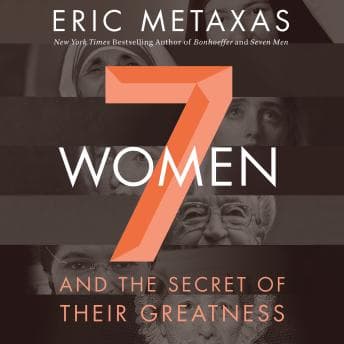
Okay, so here's my complaint: Eric Metaxas wrote a book called Seven Women about extraordinary women throughout history, and he got a man to narrate it. Tom Parks. A man. I sat in my driveway at 7:15 AM after a twelve-hour shift, engine running, staring at the garage door, thinking about this choice. And look — Parks does a fine job. His voice is warm, conversational, doesn't have that weird robotic cadence some narrators get when they're reading nonfiction. But there's something about hearing a male voice tell you about Joan of Arc's divine calling or Rosa Parks's quiet, steel-spined defiance that just... sits a little sideways. I kept wanting to hear a woman's voice carrying these stories. That's not a dealbreaker. It's just a thing I noticed at 7 AM while my brain was still in triage mode.
But let me back up.
Seven Lives, One Hour Each — And That's Both the Gift and the Problem
At seven hours total, you're getting roughly one hour per woman. Metaxas covers Joan of Arc, Susanna Wesley, Hannah More, Sister Maria of Paris, Corrie ten Boom, Rosa Parks, and Mother Teresa. That's a wild range — a medieval warrior saint, the mother of Methodism's founders, a Holocaust survivor, a civil rights icon. The biographical sketches are well-paced and genuinely interesting, especially if you're coming in cold on some of these women. I knew Corrie ten Boom's story pretty well (there was a beat-up copy of The Hiding Place in every Filipino church library I grew up in), but the section on Hannah More — an 18th-century writer and abolitionist I'd never heard of — actually had me Googling in the hospital parking lot before I drove home.
The problem is depth. One hour per life means Metaxas has to pick and choose, and sometimes the choices feel rushed. Susanna Wesley had nineteen children and essentially homeschooled all of them with a structured curriculum she designed herself — as someone who can barely get my three kids fed and out the door, that alone deserves its own book. But Metaxas breezes through her daily routines to get to her sons John and Charles Wesley, and it starts to feel like her chapter is really about them. Same issue with Rosa Parks — her section leans heavily on the Montgomery Bus Boycott (obviously), but the deeper context of her life as a seamstress, her work with the NAACP before that December day, gets compressed into a few minutes.
The Faith Framework — Know What You're Walking Into
Here's the thing Metaxas is upfront about but that I think some listeners miss: the "secret of their greatness" in the subtitle is God. Full stop. Every woman's story is framed through the lens of divine calling. Joan heard voices from saints. Corrie ten Boom's faith sustained her through Ravensbrück. Rosa Parks's courage is presented as rooted in her Christian conviction. If you're looking for a secular feminist history, this is not it. If you're looking for faith-based biography that highlights women who lived out their beliefs in extraordinary ways — this is exactly that.
I'm Catholic. My lola prayed the rosary every single night. So the faith angle doesn't bother me at all. But I'd be doing you wrong if I didn't flag it, because some listeners go in expecting a straightforward historical collection and come out feeling like they got a sermon. It's not preachy, exactly — Metaxas writes in this breezy, almost conversational way that makes even theological points feel accessible — but the framework is consistent and unmistakable.
The Mother Teresa section hit me hardest. Metaxas doesn't shy away from her decades-long crisis of faith, those years where she felt total spiritual darkness while still doing the work. As someone who's held dying patients' hands at 4 AM and wondered where God was in that room — yeah. Carlos asked why I was crying in the car. I blamed allergies.
Tom Parks Keeps It Clean and Steady
Parks reads like your smart uncle telling you family history over coffee. No dramatic character voices, no theatrical swings — which is appropriate for biography. His pacing is even, maybe a touch slow for my taste (I bumped it to 1.25x and it felt just right). The production is clean, no weird audio artifacts or volume shifts. He handles the emotional moments — Corrie ten Boom confronting her former concentration camp guard, Rosa Parks being arrested — with appropriate weight without going melodramatic. It's solid, professional work.
Night Shift Prescription
This is a good commute book. The chapter-per-woman structure means you can listen in natural chunks without losing the thread, which is perfect when you're driving home half-zombied after twelve hours. It's not going to keep you white-knuckled on the steering wheel — it's not that kind of book. But it'll make you feel something, and it'll make you think. My mom would love this (she still thinks I should've been a doctor), and honestly, I'm going to send her the link. Seven women who changed the world by answering a call. Some of us answer different calls — mine just happens to come with 3 AM alarms and compression socks. Though if you're in the mood for something that looks at the world we're all living in now — the one these women couldn't have imagined — Ten Lessons for a Post-Pandemic World gave me a lot of the same parking-lot-staring-at-nothing energy, just from a completely different angle.