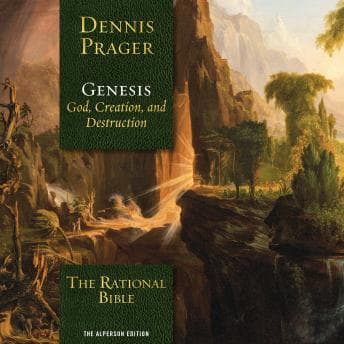

Twenty years of teaching literature, and I've never assigned a commentary as homework. But if I did? This would be the one.
Dennis Prager's approach to Genesis hit me somewhere unexpected—right in my pedagogical instincts. Here's a man who's spent forty years doing exactly what I try to do with Faulkner and Fitzgerald: making ancient texts speak to people who assume they won't care. The difference is his source material predates mine by a few thousand years.
When the Teacher Becomes the Student
I started this during late-night grading sessions, figuring religious commentary would keep me awake better than my students' five-paragraph essays on symbolism in The Great Gatsby. What I didn't expect was to find myself pausing the audio to actually think. Prager's method—and I mean this as high praise—is Socratic without being insufferable. He raises a question about the text, acknowledges the obvious interpretation, then peels back layers you didn't know existed.
Take his treatment of the dysfunctional families in Genesis. Every family. Abraham lying about Sarah being his sister. Jacob and Esau's mess. Joseph's brothers selling him into slavery. Prager doesn't sanitize any of it. Instead, he asks: why would a sacred text preserve these failures so meticulously? His answer—that the Bible is interested in moral development, not moral perfection—gave me more to chew on than most theology courses I took in undergrad.
Tom Parks delivers this with the kind of clear, measured cadence you'd want for material this dense. No dramatic flourishes, no attempt to make it "exciting." Just clean, reasoned delivery that matches Prager's rational approach. It's the audio equivalent of a well-lit classroom—nothing fancy, everything visible.
The Rational in "Rational Bible"
Prager's central promise is that he'll never ask you to accept anything on faith alone. Bold claim for a religious text. But he largely delivers. When he discusses the creation account, he's not interested in arguing young-earth versus old-earth geology. He's asking what the text is doing—what moral and philosophical framework it's establishing. The seven-day structure as a template for human work and rest. Light created before sun and moon because order precedes the physical. Whether you buy his interpretations or not, they're arguments, not assertions.
This reminds me of what Hemingway said about writing—that the dignity of movement of an iceberg is due to only one-eighth of it being above water. Prager's commentary feels like that. Forty years of Hebrew study and teaching sitting beneath every observation, but what surfaces is accessible, even conversational.
Nearly twenty hours, though. That's a commitment. I won't pretend every section held my attention equally—the genealogies get their due treatment, which is to say they're thorough but not thrilling. But Prager has a gift for finding the contemporary hook. His discussion of why Cain's offering was rejected (it wasn't about vegetables versus meat—it was about Cain's attitude) connects directly to questions my students ask about fairness and divine favoritism.
Who This Is For (And Who Should Skip It)
If you're looking for devotional warmth or inspirational uplift, this isn't it. Prager is a teacher, not a preacher. His tone is intellectual, sometimes contrarian, always confident. Some listeners might find that confidence borders on dismissiveness toward interpretations he disagrees with. Fair criticism. Skip this if you want comfort reading or can't stomach twenty hours of someone who's very sure of himself.
But if you've ever wondered why Genesis matters—or assumed it doesn't—this is worth your time. Believers will find their understanding deepened. Skeptics will find their objections taken seriously, even if not always resolved. For a different approach to sacred texts—one that leans more devotional—How to Hear from God offers practical guidance, though it lacks Prager's intellectual rigor. And literature nerds like me will appreciate watching a master close-reader work.
One listener mentioned following along with a physical Bible while listening, and I'd echo that. Not because Parks is unclear, but because the text rewards that kind of attention. The prose deserves to be savored, even—especially—when it's three thousand years old.
Worth Pausing the Faculty Meeting For
My students would probably hate this. Too long, too serious, no explosions. But that's exactly why I love it. This is the kind of patient, rigorous engagement with a foundational text that we've largely lost the appetite for. Prager's not trying to make Genesis cool or relevant in some shallow, meme-able way. He's showing that it already is—if you're willing to actually think.
Denise asked me what I was listening to last week. "A twenty-hour commentary on Genesis," I said. She looked at me like I'd finally lost it. But here's the thing: I'm already planning to restart it. This time with my Bible open and a notebook ready.
That's not something I say about many audiobooks.