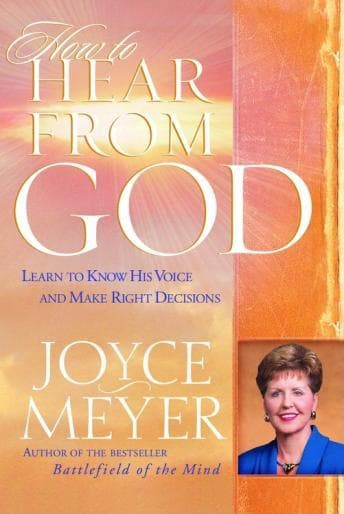

Look, I'm going to be honest - I almost didn't finish this one. Not because it's bad, but because Joyce Meyer narrates at a pace that made my 2.0x speed feel like 1.0x. My parents ran a dry cleaning business for 30 years. They didn't wait for divine guidance to decide whether to extend store hours or hire a new presser. They just did it. So a 5.5-hour audiobook about learning to hear God's voice? I went in skeptical.
The Living Room Energy
Here's what I'll give Meyer: she narrates her own book, and it works. There's something authentic about hearing an author read their own words - you can tell when they actually believe what they're saying versus when they're padding pages. Meyer believes this stuff. Her voice has this warm, grandmotherly quality that made me feel like I was getting advice from someone's wise Korean auntie at church after service. (Not my auntie - she'd tell me to work harder and worry about God later.)
The pacing though. Ugh. Even at 2.0x, certain chapters felt like they were circling the same point three different ways. I've sat through McKinsey presentations that moved faster. The key takeaway is worth the listen. The other 7 hours? Not so much. Wait - it's only 5.5 hours. Felt longer.
Where the Practical Meets the Spiritual
Okay, so here's where my consultant brain actually engaged. Meyer breaks down the different ways people might receive guidance - through scripture, through other people, through circumstances, through that gut feeling. From a decision-making framework perspective, this is basically stakeholder analysis meets intuition training. I've seen executives pay six figures for leadership coaches who teach the same concepts in secular language. Leaders Eat Last does something similar—wrapping intuition and trust-building in corporate case studies instead of scripture.
The practical application sections are genuinely useful. She talks about testing whether the guidance you think you're receiving actually aligns with your values and the outcomes you're seeing. That's just good feedback loop design. My parents did this instinctively. Now it has a TED talk. Well, an audiobook. Same energy.
But here's my issue: Meyer leans heavily on personal anecdotes. Like, really heavily. Every concept comes with a story from her life or her ministry. For some people, that's encouraging. For me? I kept thinking "okay, but how does this scale? What's the framework here?" Jenny would say I'm being harsh. Jenny is right. Not everyone needs a McKinsey deck to feel inspired.
Who Should Listen (And Who Should Skip)
Bottom line: this isn't a business book disguised as spirituality. It's a spiritual book that happens to have some decision-making applications. If you're looking for a systematic approach to improving your judgment and intuition, there are better options. If you're someone who's already faith-oriented and wants to deepen that practice while getting some encouragement along the way? Meyer delivers. Skip this if you need data-driven frameworks or can't handle repetition - you'll be checking your watch by chapter two.
I listened to this during a week of back-to-back client calls, mostly in the car between meetings. The repetition actually worked in that context - I'd zone out during a particularly dense traffic jam, come back, and Meyer would still be making the same point. Didn't miss anything. That's either a feature or a bug depending on your perspective.
The audio quality is clean and clear. No weird production issues. Meyer's voice doesn't have the dramatic range of a professional narrator, but for this type of content, you don't need that. You need sincerity. She's got that in spades.
I've seen this fail at three different companies - the idea that if you just "listen" hard enough, the right answer will appear. Business doesn't work that way. But personal life? Relationships? Big existential questions about what you're doing and why? Maybe there's something to slowing down and paying attention to the signals you're getting. My parents never stopped to listen for anything - they were too busy surviving. Part of me wonders if they should have. That tension—between self-reliance and something bigger—is what Self-Reliance wrestles with too, just from the opposite direction.
Skip to chapter 5. Thank me later. That's where Meyer gets into the practical testing framework, and it's the most useful section of the whole book. The early chapters are heavy on setup and could've been condensed by about 40%.
Final verdict: if you're already a Joyce Meyer fan, you know what you're getting and you'll love it. If you're a skeptic looking for evidence-based approaches to intuition and decision-making, this probably isn't your entry point. If you're somewhere in between - curious about faith-based approaches but want some practical takeaways - give it a shot. Just maybe bump that playback speed up.