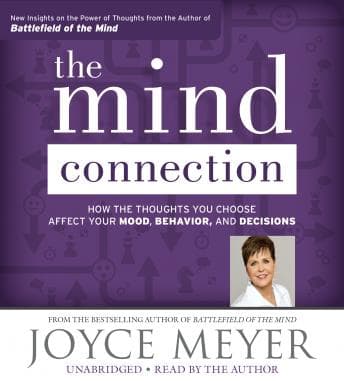

I'm going to be honest - I started this one at 5:47 AM on a Tuesday, half-asleep on a packed Caltrain, fully expecting to zone out within twenty minutes. This is not my usual genre. I'm a sci-fi person. I debug distributed systems, not my spiritual life. But my mom had been recommending Joyce Meyer for years, and I figured 6.5 hours was a reasonable experiment.
I did not zone out.
When Your Brain Is the Bug
Here's the thing about working in tech: you spend all day optimizing systems, finding bottlenecks, debugging code. Meyer's entire framework is basically that - but for your thought patterns. She treats negative thinking like a production issue. Think and Grow Rich takes a similar systems-thinking approach to mindset, though Meyer's framework feels more grounded in daily practice than Hill's success philosophy. You've got these loops running in the background (worry, doubt, self-condemnation), and they're eating up all your cognitive resources. Her solution? Identify the bad processes, understand where they're coming from, and systematically replace them.
Meyer's approach is explicitly Christian - she's working from a biblical framework, and she doesn't hide that. If you're not religious, this probably isn't for you. But if you're open to it, the practical application is surprisingly... engineered? She breaks down specific thought patterns, gives you replacement scripts, and walks through her own debugging process. It's less "just pray about it" and more "here's the specific mental architecture you need to build."
Joyce Narrating Joyce
The author-narrated thing could've gone either way. Sometimes authors are terrible readers of their own work (I'm looking at you, every tech founder who's ever recorded their own business book). But Meyer narrating her own material is genuinely the right call here. She's a preacher - this is literally what she does. Her delivery has this rhythm to it, part sermon, part therapy session, part your aunt giving you real talk at Thanksgiving.
She shares personal stories from her own life - her marriage struggles, her past trauma, the mental battles she fought for years. When she's describing her own thought spirals, you can hear the weight of it. This isn't theoretical for her. She's been in the trenches. That authenticity comes through in audio in a way it might not on the page.
No sound effects, no music, no production bells and whistles. Just Joyce talking to you for six and a half hours. And honestly? That's exactly what this book needs.
The ROI Question
Let me put on my engineer hat for a second. Is this book efficient? Could it have been shorter? Probably. Meyer repeats her core concepts multiple times, circles back to key scriptures, hammers home the same principles from different angles. If you're used to 1.75x-ing business books that could've been blog posts, this pacing might feel slow.
But I actually think the repetition is intentional. She's not trying to give you information - she's trying to rewire patterns. And that takes repetition. It's like code review: you need to see the same principles applied in different contexts before they stick.
I listened at 1.25x, which felt right. Fast enough to stay engaged, slow enough to actually absorb the material. This isn't background listening - you need to be present for it.
Who Should Queue This Up (And Who Should Skip)
Perfect for: People of faith who are stuck in negative thought loops and want a practical, structured approach to breaking them. Also surprisingly good for anyone who responds well to systematic frameworks - Meyer's method is genuinely organized.
Skip if: You're not religious and have no interest in a biblical framework. The content is inseparable from the faith component. Also skip if you want something light - this requires actual mental engagement.
Commute-worthy? Yes, but with caveats. It's not the kind of thing you can half-listen to while checking Slack. I found myself pausing it during my morning commute to actually think about what she was saying. Which is either a feature or a bug depending on what you're looking for.
End of Sprint
I finished this in about 5 commutes, and I'm genuinely surprised by how much I got out of it. Meyer's framework gave me language for mental patterns I'd been aware of but couldn't articulate. The specific thought-replacement techniques are practical - I've actually used a few of them during stressful on-call rotations.
Is this going to replace my sci-fi queue? No. But it earned its spot in the rotation. Sometimes you need to debug your own operating system, not just the ones at work.