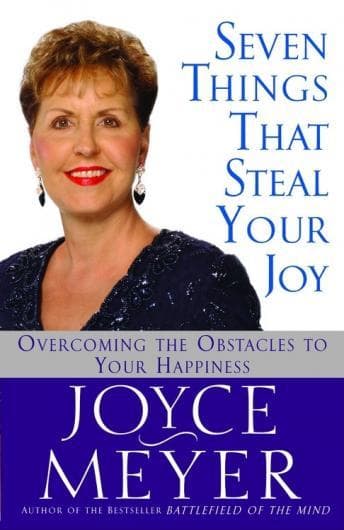

Look, I need to get something off my chest: I am so tired of self-help books that list a number in the title and then stretch one decent insight across every single chapter like it's pizza dough at a budget buffet. Seven things. Seven! You know how many things actually steal your joy? Probably three. Maybe four on a bad quarter. But Joyce Meyer committed to seven, and I braced for padding.
I was wrong. Mostly.
How a Dry Cleaner's Kid Ended Up Listening to Joyce Meyer
Jenny put this in my Audible queue. That's the honest answer. I grew up going to church every Sunday in Koreatown - not because my parents were particularly devout, but because it was the one place Korean business owners could sit down for two hours without someone asking them to press a suit. Faith was practical in our house. You prayed, you worked, you didn't complain. Joy wasn't something you chased; it was something that showed up occasionally between the 14-hour days.
So when I hit play on this at 2.0x during a Saturday morning where I was pretending to organize my home office (read: sitting in a chair staring at spreadsheets I didn't want to open), I expected the usual devotional fluff. Instead, Meyer opens with something that actually landed - she talks about joy as a decision, not an emotion. Not "think positive" nonsense, but the kind of stubborn, teeth-gritted choice to not let circumstances run your internal operating system. My mom did that every day behind a steam press. She just didn't have a book deal for it.
The Seven Things (And Which Ones Actually Hit)
Meyer's list - works of the flesh, religious legalism, self-pity, unforgiveness, guilt, negativity, and lack of confidence - reads like a diagnostic checklist. Some of these are deeply rooted in Christian theology, which, fair warning, is the entire framework here. If you're not into scripture-heavy teaching, this isn't going to convert you. But if you grew up in any kind of faith tradition, even a lapsed one, there's a weird familiarity to how she breaks things down.
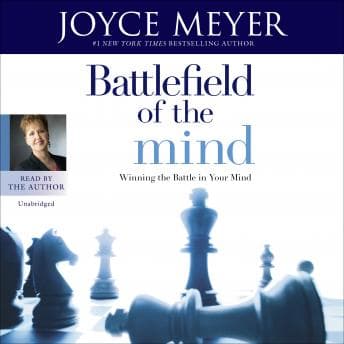
The sections on guilt and unforgiveness? Those hit different when you've watched immigrant parents carry both for decades without ever naming them. Meyer doesn't psychoanalyze - she just says stop doing it, here's why, here's the biblical basis, move on. It's the same no-nonsense approach that made Battlefield of the Mind such a hit with me—no padding, just practical faith insights. At 4 hours and 51 minutes, she doesn't have time to waste, and she doesn't. This is what my parents did instinctively. Now it has a TED talk. Well, a sermon. Close enough.
The weaker chapters - negativity, lack of confidence - felt like territory every self-help book has already strip-mined. Nothing new there. But Meyer delivers even the familiar stuff with a directness that keeps you from zoning out. She talks like she's had this exact conversation with you before and she's a little impatient that you haven't gotten it yet. Which, honestly, is the energy I respect.
Joyce Meyer Is Her Own Best Narrator (And She Knows It)
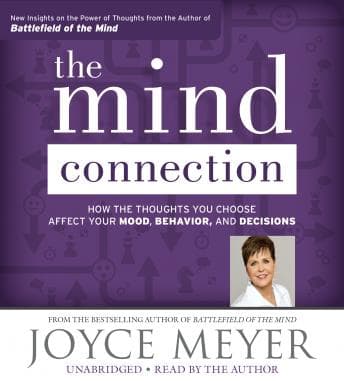
Here's the thing about author-narrated books: most of them are terrible. Authors mumble, they lose energy mid-paragraph, they read their own prose like they're seeing it for the first time. Meyer is the exception. She sounds like she's teaching a room of 500 people and making eye contact with every single one. There's a warmth there that doesn't feel performed - it feels like she's been saying this stuff for so long it's just how she talks now. Listeners who've tried her books read by other narrators say it's not the same, and I believe it. Her timing, her emphasis, the way she drops a line and pauses just long enough for it to land - that's not something you can script for a voice actor. I noticed the same arresting delivery in Mind Connection, where she turns a concept most people dismiss into something you can't ignore.
No production bells and whistles. No music. No sound effects. Just Joyce talking. And at this length, that's exactly right.
Who Gets ROI Here (And Who Doesn't)
If you're a person of faith going through a rough patch - job loss, relationship strain, that general mid-career fog where nothing feels broken but nothing feels right either - this is a solid 5-hour reset. Meyer isn't reinventing anything, but she's organizing familiar wisdom in a way that's easy to act on. The brevity alone puts it ahead of 80% of self-help books I've suffered through.
If you're looking for secular psychology, business application, or anything resembling data-driven advice, skip this. It's not for you, and that's fine.
If you're a Korean-American consultant whose wife keeps sneaking devotionals into his audiobook queue - apparently it's exactly what you needed on a Saturday morning you were planning to waste anyway. Jenny would say I'm being harsh. Jenny is right. She's also right that I needed to hear this one.
The Consulting Fee Is Under 5 Hours
Bottom line: Joyce Meyer wrote a book that respects your time, delivers with the authority of someone who's taught this material to millions, and doesn't pad. The framework is faith-based and unapologetically so. Three of the seven chapters carry real weight; the rest are solid if unspectacular. At under 5 hours, the commitment is low and the potential upside - especially if you're in a season where joy feels like a foreign concept - is real. Finally, a self-help book that respects your time.