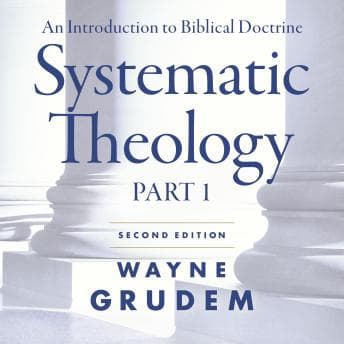

Forty hours. Forty hours of systematic theology piped into my ears, and I'm going to tell you something that would make my grad school professors faint: I think I understood more of Grudem through Tom Parks's voice than I ever did staring at the print edition during seminary prep twenty-some years ago.
Let me back up. I'm an English teacher, not a theologian. But I married Denise in a Baptist church, I've taught Milton and Bunyan and Flannery O'Connor to teenagers who think "grace" is just what you say before Thanksgiving dinner, and I've spent two decades trying to explain to sixteen-year-olds why the Western literary canon is basically incomprehensible without some working knowledge of Christian doctrine. So when I saw this sitting in my queue - all forty hours and six minutes of it - I thought: summer project. Faculty meetings don't start again until August. (Principal Martinez, you're welcome.)
Forty Hours Is a Seminary Semester for Your Ears
Here's what surprised me. Grudem's writing has always been praised for clarity, and that reputation is earned. But hearing it read aloud reveals something the page hides: the man builds arguments like a patient bricklayer. Each chapter follows the same structure - doctrine, biblical support, objections, application - and in print that can feel repetitive. In audio, it becomes rhythmic. Almost liturgical. You start to anticipate the turns, and that anticipation becomes a kind of learning.
Tom Parks narrates this like a man who respects the material without worshipping it. No dramatic flourishes, no whispered gravitas during the Trinity chapters, no sudden vocal fireworks when we hit the atonement. Just clear, measured, intelligent reading. The narrator understands that pause is punctuation - and in a book where you're being asked to hold competing theological positions in your head simultaneously (Molinism vs. classical Reformed views on divine knowledge, say, or the eternal submission of the Son debate), that steadiness is a gift. Parks doesn't editorialize with his tone. He lets Grudem's own logical scaffolding do the persuading.
Is it exciting? No. But I don't want my systematic theology exciting. I want it precise. And Parks delivers precision.
What Grudem Is Really Saying (And Who He's Arguing With)
Let's talk about what the author is really saying - because this second edition is not just a revision. It's a response. Grudem is in active conversation with open theism, the New Perspective on Paul, Free Grace theology, theistic evolution, and preterism, among others. The chapter on creation and evolution alone has been so thoroughly reworked it's practically a new book-within-a-book, with an extended critique of theistic evolution that I can already hear sparking arguments in seminary lounges.
The updated material on the Trinity - specifically the eternal relationship between Father and Son - is where you feel Grudem pushing back hardest against his critics. He's been in the middle of that controversy for years, and the new content reads (well, sounds) like a man who's had time to think carefully about the pushback and wants to make his case one more time, with receipts. Whether you agree with him or not, the intellectual honesty is real. He names his opponents. He quotes them fairly. Then he explains why he thinks they're wrong.
I was listening to the impassibility of God section while walking the lakefront at six in the morning - Denise was still asleep, the joggers hadn't shown up yet, just me and Lake Michigan and the question of whether God suffers. That chapter hit differently at dawn with the water flat and gray. Sometimes the listening context finds you.
The Audio Practicalities (Because Forty Hours Is No Joke)
Here's the honest part. This is not a casual listen. You can't absorb the doctrine of substitutionary atonement while doing dishes. I tried. I had to rewind three times during the chapter on Christ's resurrection because I'd drifted into thinking about whether I'd remembered to email a parent back. This is focus listening. Period.
The accompanying PDF with Scripture memory passages, key terms, and hymn suggestions is essential if you're using this for actual study. Without it, you're getting maybe 70% of the experience.
Parks narrates at a pace that works well at 1.0x - the prose deserves to be savored, even when it's theological argumentation rather than Faulkner. I wouldn't speed this up. The density of the content means your brain needs that processing time between sentences. My students would hate this. I love it.
One note: because this is Part 1 of a larger work, it ends mid-system. You get through the doctrines of Scripture, God, Man, Christ, and the Holy Spirit, but ecclesiology, eschatology, and the rest live in Part 2. Just know what you're getting into.
Who This Is For (And Who Should Run)
If you're a serious Bible student, a seminary student, a pastor, or - like me - someone who teaches literature and keeps bumping into theology whether you planned to or not, this is worth your time. If you loved reading C.S. Lewis's Mere Christianity and wanted someone to go deeper, chapter by chapter, with actual exegesis? This is its spiritual successor in audiobook form. Though if devotional and warm is actually what you're after, I spent time with Brush of Wings earlier this year - it won't give you a single footnote, but it takes the same theological territory and drapes it in story instead of argument.
If you want something devotional and warm, this ain't it. Grudem is a professor, and this sounds like a professor. A very good, very organized, very thorough professor. But a professor.
Worth pausing the faculty meeting for - if you've got the attention span and the appetite for it.