
Most people assume a Bible commentary delivered by a conservative talk show host is going to be a sermon dressed up as scholarship. I assumed the same thing. Seventeen hours later, walking the lakefront with Denise on a gray Sunday morning while Prager was dissecting the tenth plague, I realized I'd been wrong about what this book was trying to be - and mostly right about what it actually is.
Let me explain both.
A Talk Radio Host Walks Into a Seminary
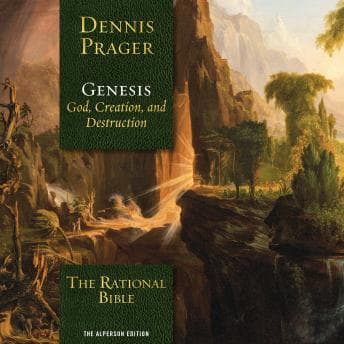
Dennis Prager has been teaching Torah for forty years, and it shows - not always in the ways you'd expect. The format here isn't narrative. It's verse-by-verse commentary, which means you're getting Exodus broken into pieces with Prager's analysis layered on top of each fragment. Think less audiobook, more extended lecture series. And honestly? That's where the comparison to his Genesis volume matters. If you listened to that one (also narrated by Tom Parks), you know the rhythm: Scripture passage, then Prager's interpretation, then a tangent connecting the text to modern ethics or politics, then back to Scripture. Exodus follows the same template but the material is richer - the Ten Commandments alone give him enough to talk about for what feels like three hours.
What separates this from a typical devotional commentary is Prager's insistence on reason over faith as the entry point. He's not asking you to believe first and understand later. He's making arguments. Some of them are genuinely sharp - his analysis of why the Exodus narrative structures God as liberator rather than just creator, and why that distinction matters for Western civilization's concept of freedom, is the kind of thing I wish I could assign to my AP students. I had a similar reaction to Jesus on Trial, where another non-academic makes a sustained, reason-first case about a foundational religious text - and lands more often than you'd expect someone outside the seminary to. His breakdown of the Hebrew word for "slave" versus how the King James Version translates it, and what that mistranslation has meant for centuries of moral confusion about biblical slavery, is worth the listen on its own.
But here's the thing. Prager is also Dennis Prager. The man has opinions about everything, and he doesn't always separate his exegesis from his editorializing. There are stretches - particularly when he connects Exodus to contemporary American politics - where the commentary feels less like a scholar teaching and more like a segment from his radio show. If you're coming to this purely for the biblical analysis, those moments will feel like detours. If you're already in his audience, you won't notice. This isn't a criticism exactly, just a heads-up about what you're signing up for.
Tom Parks Does the Heavy Lifting You Don't Notice
Seventeen hours of commentary narration is a brutal assignment. There's no plot momentum carrying you forward, no character voices to switch between, no dramatic tension to lean on. It's one man's ideas, read by another man, for the length of a transatlantic flight. Tom Parks handles this about as well as anyone could.
His delivery is measured and clear - almost professorial, which suits the material. He doesn't try to dramatize the Scripture passages or add vocal flourish to Prager's arguments. The narrator understands that pause is punctuation, and Parks uses silence well between sections, giving you a beat to process before the next verse arrives. It's the kind of performance you appreciate most when you imagine how bad it could've been. A narrator who punched up the energy or tried to make this "exciting" would've ruined the whole project.
That said - and this is a 17-hour listen, so it matters - there's a flatness that creeps in during the longer analytical stretches. Around hour 9 or 10, when Prager is deep into the laws governing property and liability (yes, Exodus has those), Parks' even tone starts to work against him. I found myself rewinding more than usual, not because the content was bad but because the delivery didn't signal "pay attention, this part matters" versus "this is background setup." For a book that demands focused listening, that's a real limitation.
Who This Is Actually For (And Who Should Keep Walking)
If you loved Prager's Genesis volume, this is its spiritual successor - same approach, arguably better source material. If you're interested in Jewish biblical interpretation and you don't mind that your guide has a political worldview that's going to show up uninvited from time to time, there's genuine intellectual substance here. My students would hate this. I love it. Not all of it. But enough of it.
If you want pure academic biblical scholarship without ideological seasoning, look elsewhere. If you need narrative drive in your audiobooks, this will feel like homework. And if 17 hours of verse-by-verse analysis sounds like a faculty meeting that never ends - well, I survived those too, but at least during those I had Middlemarch.
The Lesson Plan I'd Actually Use
Prager's central argument - that Exodus is the foundational text for human liberty and moral law, and that dismissing it as primitive is intellectually lazy - is stronger than I expected. Not bulletproof, but strong. The prose deserves to be savored in places, particularly his writing on the Sabbath commandment and why rest is a revolutionary concept. Parks delivers it all with quiet competence. For a reason-based walk through one of the most important texts in human history, you could do a lot worse. You could also do better in spots, but that's true of most things worth spending 17 hours on.
Worth pausing the faculty meeting for. Selectively.