
"The buck stops here."
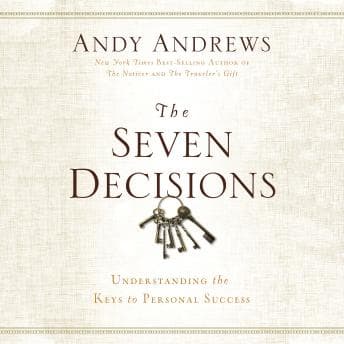
Andy Andrews drops that Truman quote early on - not as decoration, but as the spine of his first decision, the Responsible Decision. And I was stirring chana masala at 10 PM thinking, okay, self-help book, I know where this is going. Except Andrews did something I wasn't expecting. He didn't just hand me seven tidy principles and call it a day. He wrapped each one in biographical evidence - real people, real disasters, real comebacks - and somewhere between Harry Truman's political near-death experiences and the story of a young Andrews living homeless under a pier, I stopped stirring.
Here's the thing about self-help as a genre: most of it makes me want to scream into a pillow. I study why humans do what they do for a living, and the research actually shows that most behavioral change frameworks fail not because the principles are wrong, but because they're presented without psychological scaffolding. You can't just tell someone to "choose joy" and expect their prefrontal cortex to cooperate. So I came into this one armed with skepticism and a wooden spoon.
The Biographies Are Doing the Heavy Lifting
What makes this book work - when it works - is that Andrews is essentially building case studies. Each of the seven decisions gets illustrated through multiple real lives: presidents, athletes, business leaders, and Andrews himself. This is narrative psychology whether he calls it or not. The Persistent Decision, for instance, doesn't just say "don't quit." It walks through specific moments where quitting was the rational choice and persistence was borderline delusional - until it wasn't. The protagonist of each story exhibits classic confirmation bias reversal: they believed in outcomes that had zero supporting evidence, and the belief itself restructured the evidence.
Psychologically, this tracks. Self-efficacy theory (Bandura, if you're keeping score) suggests that watching others succeed in similar circumstances is one of the strongest predictors of behavior change. Andrews is essentially doing vicarious modeling through audio storytelling. He just doesn't use those words. He uses stories about people sleeping in their cars.
But - and this is where the academic in me gets twitchy - the framework oversimplifies. Seven decisions. Clean categories. Life doesn't sort itself into seven anything. The Certain Decision and the Active Decision blur into each other constantly, and Andrews doesn't really address what happens when two of his decisions conflict. What if the Compassionate Decision requires you to abandon the Persistent one? What if being Responsible means being less Joyful for a while? The research on value conflicts in decision-making is robust and fascinating, and I found myself asking: why does Andrews never acknowledge the tension between his own principles?
Andrews the Narrator vs. Andrews the Author
Here's where author-narrated self-help has an inherent advantage. Andrews wrote these words. He lived the homeless-under-a-pier chapter. So when his voice cracks slightly during the personal stories - and it does, you can hear the emotional weight shift - it's not performance. It's memory. That distinction matters.
His delivery is conversational, Southern-tinged, and warm without being saccharine. He sounds like that uncle who tells great stories at Thanksgiving and somehow makes you feel like you should call your mother more often. At 6.5 hours, it's digestible. I got through it across two cooking sessions and a Sunday morning jog through Cambridge (my therapist would appreciate that I'm integrating the Active Decision without meaning to).
The downside? There's a motivational-speaker cadence that creeps in during the more prescriptive sections. You can feel the stage beneath his feet. When Andrews is telling a story, he's magnetic. When he's delivering the "action steps" at the end of each decision section, the energy shifts to seminar mode, and I started mentally drafting my grocery list. The book is strongest in anecdote and weakest in application, which is ironic for a book that's supposedly all about application.
Who This Is Actually For (And Who It Isn't)
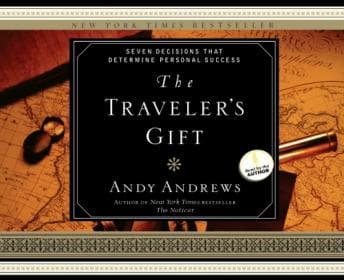
If you've read The Traveler's Gift, this is the expanded director's commentary. Same seven decisions, deeper biographical material, more explicit how-to framing. If you haven't read it, this stands alone fine.
This is genuinely useful for someone in a stuck moment - job loss, relationship collapse, that 3 AM what-am-I-doing-with-my-life spiral. The biographical examples provide what psychology calls "possible selves" - models of who you could become. That's powerful stuff when you're in the dark. Life Without Limits does something similar with the 'possible selves' mechanism - Nick Vujicic's story is essentially one long vicarious modeling exercise, and it lands harder than most because the gap between his circumstances and his outcomes is so extreme it short-circuits your skepticism.
But if you want empirical rigor? If you want citations, controlled studies, acknowledgment of systemic barriers to success? You won't find that here. Andrews operates in the Great Man theory of personal development: extraordinary individuals made extraordinary choices. My therapist would have thoughts about the absence of any discussion of privilege, mental health barriers, or structural inequality in these success narratives. So do I.
My Case File Notes
I'm giving this a qualified recommendation. Andrews understands something fundamental about human motivation: we don't change because of bullet points. We change because of stories. The biographical approach is psychologically sound even when the framework is too neat. At 1.25x speed, the seminar-mode sections become bearable, and the stories still land. It won't replace therapy or a good behavioral psychology textbook. But at 2 AM when the chana masala is done and you're eating alone and wondering if you've made the right choices - it's not a bad voice to have in your ear.