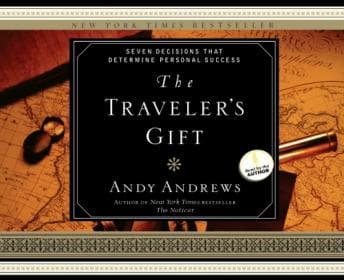

Look, I'll be honest with you. When I first saw the premise—a desperate executive travels through time to meet historical figures who teach him life lessons—my inner psychologist immediately started raising objections. This is the kind of setup that usually makes me reach for the skip button. Time travel as a vehicle for self-help? Really?
But here's where Andy Andrews surprised me.
The Psychology Behind the Gimmick
So yes, David Ponder meets Harry Truman, Anne Frank, Christopher Columbus, and others. Yes, each encounter conveniently delivers one of the seven decisions for success. And yes, if you're looking for psychological realism, this isn't it. The human mind doesn't actually work in neat seven-step frameworks. (My dissertation committee would have thoughts.)
But that's not really the point, is it? Andrews is doing something interesting here—he's using what we call in narrative psychology a "wisdom transmission" structure. Ancient cultures did this with parables. Religious traditions do it with allegory. Andrews just adds a time machine.
What actually works is how the historical figures aren't just spouting advice. They're contextualized in their struggles. Anne Frank doesn't just tell David to "choose to be happy"—she's doing it from the annex. That context matters. The research shows that lessons embedded in emotional narrative stick better than abstract principles. Andrews gets this intuitively, even if the execution sometimes veers into Hallmark territory.
When Andy Reads Andy
Here's the thing about author-narrated audiobooks: they can go either way. Sometimes authors have no business behind a microphone. But Andrews? He's a professional speaker, and it shows. His delivery is warm without being saccharine, clear without being clinical.
The character voices aren't elaborate—this isn't a full-cast production—but he gives each historical figure enough distinction that you're never confused about who's speaking. His Harry Truman has a different energy than his Abraham Lincoln. It's subtle work.
I found myself tearing up during the Anne Frank section, and I'm not particularly easy to move. (Don't tell my students I said that.) Whether that's the writing or the delivery, I honestly can't separate them. Maybe that's the point of author narration—you get the emotional intent exactly as intended.
The Cheese Factor—Let's Address It
I'm not going to pretend this book doesn't have cringeworthy moments. Some of the dialogue made me pause my run just to process. There are lines that feel like they belong on a motivational poster in a middle school counselor's office.
But—and this is a big but—the underlying principles aren't wrong. "The buck stops here." Taking responsibility. Persisting when things are impossible. Seeking wisdom. These aren't revolutionary ideas, but they're presented in a way that's surprisingly sticky.
The protagonist exhibits classic learned helplessness at the beginning—he's lost his job, his family is struggling, he's contemplating the unthinkable. The journey, cheesy as it is, functions as a cognitive reframe. He's essentially being given new mental models through experiential learning. It's not how therapy works, but it's not entirely divorced from how humans actually change either.
Skip It or Queue It?
I listened to this during my morning jogs through Cambridge, and honestly? It's perfect commute or workout material. At just under five hours, it's a quick listen. The pacing is steady—not slow, not rushed. The production is clean.
If you're a cynic who needs literary complexity, skip this. If you're allergic to anything that smells like motivational content, definitely skip this. But if you're in a rough patch and need something that's going to gently but firmly remind you that you have agency? This might hit different than you expect.
The Diagnosis
I went in ready to analyze why this book shouldn't work. I came out understanding why it became a bestseller. Gambler did something similar—took unconventional wisdom and made it stick through raw storytelling. The human mind craves narrative structure for difficult truths. Andrews provides that structure. Is it a work of psychological insight? No. Is it effective? Surprisingly, yes.
My therapist would probably approve. Probably.