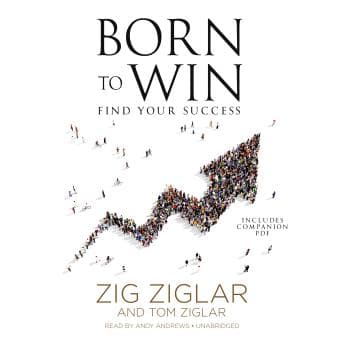

So here's the thing about Zig Ziglar — I grew up hearing his name from my parents' self-help CD collection in our Seattle basement, and I always assumed the material was dated in that cheesy 90s motivational poster kind of way. Then I grabbed Born to Win at 2AM after a particularly brutal on-call shift where three microservices decided to fail in cascade, and I needed something aggressively optimistic to counteract the existential dread of watching dashboards turn red. And honestly? My expectations were wrong. Partially.
The Ziglar Greatest Hits Compilation You Didn't Ask For
TL;DR: Worth your commute if you've never read Ziglar. Skip if you own more than two of his other books.
This is basically Ziglar's 30+ book catalog distilled into a 4.5-hour highlight reel, co-written with his son Tom. The framework centers on seven key life areas — mental, spiritual, physical, family, financial, personal, and career — and argues you can't truly win unless you're building across all of them. It's the "you need to load balance your life" argument, which... yeah, as someone who spent last Tuesday eating cold pizza over a laptop at midnight debugging a race condition, I felt personally called out.
The good: Ziglar's core ideas about goal-setting are surprisingly systematic. He doesn't just say "dream big" and leave you hanging. There's a concrete planning-to-execution pipeline here — identify what you want, break it into daily actions, track progress, adjust. It's basically Agile for your personal life, except Ziglar figured this out decades before anyone started doing stand-ups. The same systematic goal-breaking approach shows up in TenX Rule, though Grant Cardone cranks the intensity dial so far past Ziglar's warmth that it almost becomes a different genre entirely. The section on behavioral styles and how different communication approaches affect relationships had me thinking about my last three 1:1s with my manager. Practical stuff.
The bad: If you've read See You at the Top or Over the Top, you're going to hit massive overlap. Like, "I've seen this code in another repo" levels of duplication. I kept waiting for the new insight that justified this being its own book versus an appendix, and it didn't always come. For Ziglar completists, this feels like the farewell tour where he plays the hits one more time. Which is fine emotionally — this was his last book — but the ROI drops significantly if you already own the back catalog.
Andy Andrews Is Not Zig Ziglar (And That's the Problem)
Okay, the elephant in the room. Andy Andrews narrates this, and he periodically attempts to channel Zig's famous speaking style — the cadence, the enthusiasm, the down-home Southern delivery. And look, I get why they did it. Ziglar's voice IS the brand. But Andrews doing Ziglar impressions is like when someone forks an open-source project and tries to maintain the original maintainer's commit style. It's uncanny valley territory. You can hear him lean into what he thinks Zig would sound like, and it pulled me out of the content every single time.
When Andrews just narrates as himself? Totally fine. Energetic, clear, professional. The passion is genuine. But those impersonation moments — and they happen a lot — land somewhere between tribute and cringe. I found myself wincing on the 7:15 AM express to Mountain View more than once. At 1.75x speed (because yes, this is a business book that could've been a blog post in places), the impression attempts become even more noticeable because the vocal shift is compressed.
I kept thinking: they should've just used archival Ziglar audio clips for the quotes and let Andrews handle the connective tissue. That would've been a genuine tribute.
Who Gets the Most Out of This
Perfect for: train, gym. Skip for: deep work.
If you're Ziglar-curious and want a single-volume entry point into his philosophy, this is actually a decent starting package. 4.5 hours is nothing — I finished this in 3 commutes — and you'll walk away with the core framework. First-timers will get real value here.
If you're already a Ziglar reader, this is a skim-at-best situation. The material overlaps too heavily with his other works to justify a credit. Borrow it from Libby, listen to it while doing laundry, absorb the nostalgia, move on.
And if narrator voice is make-or-break for you (hi, fellow Ray Porter devotees), test the sample first. Andrews' Ziglar impressions are polarizing enough that they might kill the experience for you entirely.
The Commit Message
Born to Win is a legacy book — both in the "final work of a legend" sense and in the "this codebase has been around forever" sense. The foundation is solid. The principles work. But the narration choice introduces friction where there shouldn't be any, and the lack of genuinely new material makes this hard to recommend at full price for anyone already in the Ziglar ecosystem. For newcomers to motivational self-help who want something structured and short? Decent entry point. For everyone else, your credit's better spent elsewhere. The seven-life-areas framing also reminded me of Single On Purpose, which tackles the same "you can't optimize just one dimension" argument but from a completely different angle — and lands about as mixed for me.
Kevin listened to half of this with me on a weekend drive to Tahoe and said, "This is fine but it's no Bobiverse." Reader, he is technically correct. The best kind of correct.