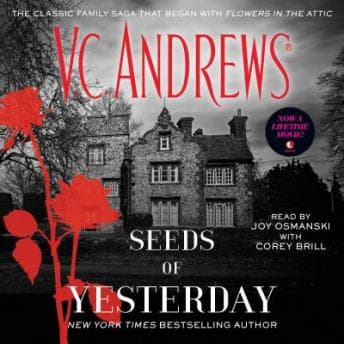

What does it mean when the place that broke you becomes the place you have to return to? That's the question V.C. Andrews keeps circling in Seeds of Yesterday, the fourth Dollanganger book, and honestly the one where the whole gothic machine finally grinds to its ugly, inevitable conclusion. Cathy and Christopher - siblings, lovers, survivors of Foxworth Hall - are dragged back to that house one more time because their son Bart has inherited it. Bart, who is disturbed in the specific, operatic way only a V.C. Andrews character can be disturbed. Bart, who has spent his entire life being the wound the family keeps reopening.
I listened to most of this during a late-night lakefront walk with Denise, which in retrospect was the right call. There's something about the cold off Lake Michigan at 10 PM that matches Andrews' particular brand of melodrama - everything feels slightly unreal, slightly too large, slightly like you're in a story someone else is telling about you. That's exactly the atmosphere Seeds of Yesterday needs. This is a book about inheritance in every sense: property, trauma, the sins of parents landing on children who didn't ask for any of it. Quiroga was doing something similar with inherited dread in Cuentos de Amor de Locura y de Muerte — that same sense of doom passed down like a family heirloom nobody wants but nobody can throw away. My students would hate this. I find it genuinely interesting as a study in how gothic fiction uses architecture as psychology. Foxworth Hall isn't just a house - it's the externalization of everything the Dollanganger family refuses to bury.
The Story Has Real Teeth. The Narration Has a Problem.
Here's where I have to be honest with you, the way I'd be honest with a student who turned in a paper with a strong thesis and shaky execution. The book itself is doing something. Andrews is working through the full weight of what she started in Flowers in the Attic - the forbidden relationship between Cathy and Christopher finally exposed, Bart's psychological unraveling given room to breathe, the generational rot of the Dollanganger name examined from every angle. There's a scene where Bart essentially performs a version of his grandfather's cruelty back at his own family that made me stop walking entirely. Denise had to ask if I was okay. That's the book working.
Joy Osmanski's narration is where it gets complicated. The listener complaints I'd heard before starting this were specific enough to worry me, and they turned out to be accurate. Her male voices - particularly Christopher, who is supposed to be warm, thoughtful, the emotional anchor of this entire series - come across as cold and vaguely hostile. Every time Christopher speaks, he sounds like he's delivering a verdict, not a comfort. For a character who has spent four books being Cathy's steadiest presence, that's a significant misread. The narrator understands that pause is punctuation, but Osmanski's pauses here feel less like interpretation and more like uncertainty. The delivery flattens out in the longer expository passages, and for a 15-hour listen, that flatness accumulates.
I listen at 1.0x because the author chose those words. But I'll admit there were stretches of this where I caught myself thinking about Principal Martinez's last budget presentation with more engagement than I was giving the audiobook. That's not a good sign.
Who This Is Actually For
If you've read the first three Dollanganger books and you need closure, you need this story. The plot delivers what it promises - the reckoning happens, the secrets surface, the Hall earns its reputation one final time. If you're a completionist who's already invested fifteen-plus hours in this family, you're going to finish it regardless of what I say here.
But if you're newer to the series, or if you're someone who came to Andrews through the Lifetime movies and wants to experience the books for the first time in audio - I'd genuinely suggest finding another format for this one. The narration creates a specific problem: it makes Christopher sound like an antagonist, which distorts the emotional logic of the ending. Andrews spent four books building toward what Cathy and Christopher represent to each other. When Christopher's voice sounds cold, the ending loses its particular bittersweet weight.
This is why we still read the classics - or in Andrews' case, the gothic pulp that functions like a dark mirror of classic themes. The Dollanganger series is Faulkner's Yoknapatawpha County if Faulkner had been writing for maximum emotional impact and minimum restraint. The prose deserves to be savored. This audiobook version makes that harder than it should be.