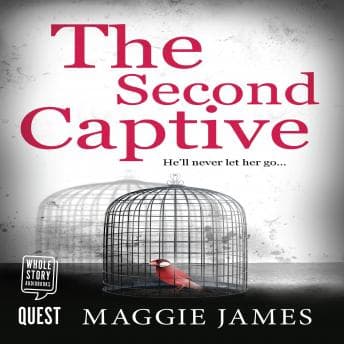

Look, I need to rant about something first. The pauses in this audiobook. THE PAUSES. I'm driving home from a twelve-hour shift at 7 AM, already fighting to stay awake, and suddenly there's dead silence so long I'm checking my phone at red lights thinking the app crashed. It didn't crash. Charlie Sanderson just... pauses. A lot. Like, "contemplating the meaning of existence" level pauses.
I bumped it up to 1.25x speed after the first hour and never looked back. Problem solved, sanity preserved.
The Psychology Is Disturbingly Accurate
Here's the thing - I've worked with trauma patients. I've seen what captivity and abuse do to people, how the brain rewires itself to survive impossible situations. Maggie James clearly did her homework on Stockholm syndrome, and it shows in ways that made me grip my steering wheel a little tighter.
Beth's relationship with her captor Dominic doesn't follow the Hollywood version where victims are either completely broken or secretly plotting revenge. Instead, it's this uncomfortable, realistic middle ground where she's simultaneously terrified of him and dependent on him. The way her internal logic shifts to accommodate her survival - that's real. I've seen versions of that in patients who've experienced long-term abuse. Your brain does what it needs to do to get you through.
Part One is the captivity itself, and it's claustrophobic in the best way. Part Two deals with the aftermath, and honestly? That's where the book got me. Because everyone focuses on the dramatic rescue, the escape, the "it's over now." Nobody talks about how you're supposed to just... go back to being a normal person after something like that. Girl on the Train explores that same aftermath—how trauma reshapes your entire reality, even after the immediate danger is gone. How do you eat dinner with your family when you spent months eating whatever your captor decided to give you?
Charlie Sanderson's Quiet Devastation
Once you speed past those pauses, Sanderson actually delivers something pretty powerful. The emotional manipulation scenes hit because she doesn't oversell them. There's this quiet quality to Beth's voice that captures how trauma makes you small, how you learn to take up less space. The shift between Beth, Dominic, and Ursula is there - not dramatic voice changes, but enough that you track who's speaking.
The Stockholm syndrome moments are particularly effective. Sanderson doesn't play them as shocking revelations. Instead, they creep up on you, and by Part Two, you realize how thoroughly Beth's perspective has been warped. That subtlety requires skill.
(Carlos asked why I was sitting in the driveway for ten extra minutes last Tuesday. I blamed a work call. Really I was processing this book.)
Not Your Typical Thriller Pacing
This is not a fast-paced kidnapping thriller. If you want action sequences and narrow escapes, look elsewhere. Second Captive is a psychological study wearing thriller clothes. The tension comes from watching Beth's mind adapt to captivity, not from wondering if she'll escape. Husband's Secret works the same way—you're not waiting for the reveal, you're watching the psychological unraveling. You know she will - the structure tells you that much. The question is what version of Beth survives.
At nearly eleven hours, it's a commitment. The slow pacing works for the subject matter - captivity is monotonous, after all - but combined with those pauses, it can drag if you're not in the right headspace. This is not a background-while-you-clean book. You need to pay attention.
Who This Is (and Isn't) For
If you work in mental health, trauma care, or any field where you've seen what humans can survive (and what it costs them), this will ring uncomfortably true. Fans of psychological depth over plot twists will appreciate James's approach.
Skip this if you need action to stay engaged, if slow pacing makes you crazy, or if captivity narratives are triggering for you. The content warnings are real - psychological abuse and manipulation are portrayed in detail.
Clocking Out
This one earned its place in my post-shift rotation, but with conditions. Speed it up. Give it your full attention. And maybe don't start it when you're already emotionally depleted from a rough shift.
The research is solid, the psychology is accurate, and the aftermath gets more attention than the trauma itself - which is exactly how it should be. Not every book about captivity understands that the escape is just the beginning. This one does.
My mom would probably hate this. Too dark, she'd say. But she'd also recognize the accuracy. Fifteen years in healthcare teaches you that the human mind is both more fragile and more resilient than anyone wants to admit. Second Captive captures both sides.