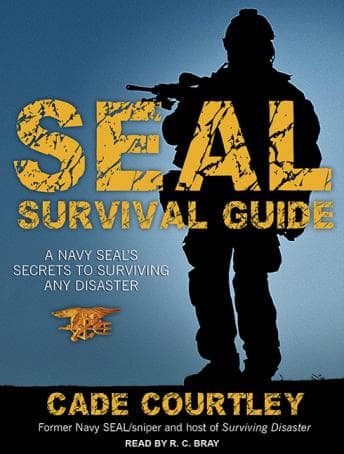

Look, I'm going to be upfront about something that bugged me: if you're expecting this book to teach you the mystical SEAL mindset - that warrior philosopher thing where you learn to become one with your inner operator - you're gonna be disappointed. I spent the first hour waiting for the deep psychological stuff and instead got very detailed instructions on how to treat a sucking chest wound. Which, honestly? Probably more useful if I ever actually need it.
Once I recalibrated my expectations, this became a surprisingly solid commute companion. Cade Courtley basically treats every disaster scenario like a distributed systems problem: identify the failure mode, isolate the issue, apply the fix, move on. My engineering brain appreciated that structure way more than I expected.
R.C. Bray Does the Heavy Lifting
Okay, can we talk about how R.C. Bray is basically the narrator equivalent of a well-optimized algorithm? The guy just works. He reads survival instructions about improvising weapons from everyday items with the same authoritative calm that makes you think, "Yeah, I could definitely do that." (I could not. But I believed it in the moment.)
The pacing is excellent - not too fast that you miss critical steps, not so slow that you zone out during the "how to survive extreme cold" section. And trust me, that section is long. I finished it during a particularly brutal Monday commute where Caltrain was delayed by 40 minutes, so at least I learned how to not die in a blizzard while freezing in an unheated train car. Irony.
The Go-Bag Section Alone Is Worth It
Here's where I have to give Courtley credit: the ROI on this audiobook is surprisingly high for the "hope I never need it" category. The go-bag section alone is worth the listen - I actually paused during my commute to add items to my Amazon cart. (Kevin found the tactical first aid kit in our apartment and asked if I was planning for the apocalypse. I told him it's called being prepared, and also he should read the chapter on pandemic survival because clearly we learned nothing from 2020.)
The book covers everything from active shooter situations to wildfires to car accidents. It's basically a debugging guide for life-threatening scenarios. That same methodical, no-nonsense approach is what made No Excuses! work for me—breaking down self-discipline into concrete, actionable steps instead of vague inspiration. Each section follows a clear pattern: here's the threat, here's how to assess it, here's your step-by-step response. Very user-friendly, very practical.
Now, the pro-gun stuff. Yeah, it's there. Courtley doesn't apologize for it, and if that's a dealbreaker for you, fair enough. Personally, I just mentally tagged those sections as "not applicable to my California existence" and moved on. The rest of the content stands on its own.
Where It Drags
At almost 10 hours, there are definitely sections where my attention wandered. The extreme climate survival chapters felt repetitive after a while - yes, I understand hypothermia is bad, we've covered this. And some of the disaster scenarios felt padded to hit a word count. Could've been a tighter 7 hours, easy.
Also, if you're looking for war stories or SEAL training insights, this ain't it. Courtley keeps things focused on practical application, which is both a strength and a limitation depending on what you're after.
Queue It For: Train, Gym. Skip For: Deep Work
This is basically a survival manual optimized for audio format. You don't need to take notes (though I did for the go-bag stuff), and you can follow it at 1.25x without missing anything critical. R.C. Bray's delivery keeps it engaging even when the content gets dry.
Who should listen: Practical-minded folks who want actionable disaster prep without military memoir fluff. Great for commuters who want to feel slightly more prepared for emergencies. Skip if: you want SEAL philosophy, war stories, or can't tolerate pro-gun content.
I finished this in about 4 commutes, and honestly? I feel slightly more prepared for disasters now. Whether that's actual preparedness or just the placebo effect of having listened to a SEAL talk about survival for 10 hours, I can't say. But I'll take it.
Sarah's Bottom Line
Worth your commute if you want practical survival skills delivered like good documentation: clear, structured, no fluff. Just don't expect a deep dive into the SEAL psyche - this is a how-to guide, not a philosophy book. And R.C. Bray makes the whole thing go down smooth.