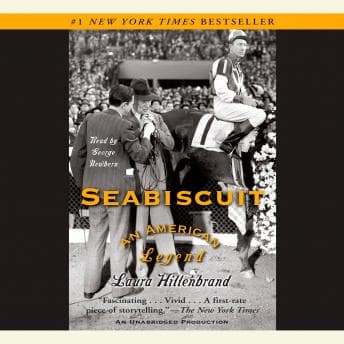

"More people went to see Seabiscuit race than went to see Roosevelt." Somewhere around hour three, that line hit me, and I had to pause my walk and just stand there on the sidewalk like an idiot. Because I'd been treating this as a horse book. It's not a horse book. It's a Depression-era business case study disguised as a horse book, and it's better than 90% of the actual business books in my Audible library.
Three Broken Men and a Horse Nobody Wanted
Here's the setup, and tell me this doesn't sound like every startup pitch deck I've ever reviewed: A bicycle repairman pivots to automobiles and becomes a millionaire. A half-wild mustang breaker with zero formal credentials gets hired on instinct. A one-eyed, quote-spouting failed boxer becomes the jockey. And the horse? Crooked legs, bad attitude, slept twenty hours a day. Literally pathologically lazy.
Charles Howard, Tom Smith, Red Pollard, Seabiscuit. Four misfits. Zero pedigree advantages. And Hillenbrand builds their stories with the kind of meticulous research that would make any McKinsey partner weep with joy. She doesn't just tell you Howard sold cars - she maps the entire economic transformation of the American West through one man's dealership. She doesn't just say Pollard was tough - she traces the path from a privileged Canadian childhood to sleeping in horse stalls and fighting in underground boxing rings. Blind in one eye. Quoting Emerson between bouts. You can't make this up.
This is what my parents did instinctively. Now it has a TED talk. The grind, the refusal to quit, the idea that you could take something the establishment threw away and make it extraordinary through sheer stubborn work - my dad pressing shirts at 5 AM would've understood Tom Smith better than any racing executive ever did.
Hillenbrand's Secret Weapon Is Patience (And I Say That at 1.5x)
Look, 13 hours and 14 minutes. That's a commitment. I started at my usual 2.0x and had to slow down, which physically pains me to admit. But Hillenbrand earns her runtime. She's building context - the Great Depression, the rise of automobile culture killing the horse industry, the birth of radio sports broadcasting - and every piece of it pays off later. Nothing is wasted. When she finally gets to the match race against War Admiral, you understand why the entire country stopped to listen. Forty million people on the radio. For a horse race. She makes you feel why.
George Newbern's narration is steady, understated, and smart enough to get out of Hillenbrand's way. He's not doing voices or accents - this isn't that kind of book. He reads it like a really good long-form journalist telling you the most incredible story he's ever found, and the restraint works. The race sequences could've gone theatrical, but Newbern keeps them tight, lets the writing do the heavy lifting. It's not a performance that'll win narrator-of-the-year debates, but it's the right performance for this material. Solid 4.
My one gripe: the middle sections covering the various racing seasons can blur together if you're not locked in. Chapters covering race after race after race - I lost the thread once during a client call (yes, I was multitasking, no, I'm not sorry). This is not a background listen. You need to be present.
The Business Book That Doesn't Know It's a Business Book
I keep coming back to the business parallels because they're inescapable. Howard's marketing genius - painting Seabiscuit as the people's horse while War Admiral represented old money. That's brand positioning. Smith's training philosophy - watching the horse, adapting to the horse, not forcing a system onto an animal that didn't fit systems. That's management consulting done right. The way all three men handled catastrophic setbacks - Pollard's shattered leg, Seabiscuit's torn ligament, Howard's personal tragedy - and came back. That's not a chapter in a self-help book. That's the whole book.
Jenny caught me tearing up during the final race and I told her it was allergies. In March. She didn't buy it. She was right not to.
Hillenbrand wrote this entire book while battling chronic fatigue syndrome so severe she couldn't leave her house. She researched it through mail correspondence and phone calls. That fact alone should humble every author who's ever complained about their writing process. The obsessive, against-all-odds research reminds me of what made Mysterious Case of Rudolf Diesel so compelling - another writer who refused to let a forgotten story stay forgotten, piecing together a vanished world from scraps.
Who Gets the Most Out of This
Anyone who thinks they know this story from the movie - you don't. The movie is the PowerPoint summary. This is the full analysis. Founders, operators, anyone grinding through their own version of crooked legs and long odds. Sports fans, history fans, people who want to understand Depression-era America through something other than a textbook. Skip if you need constant action - there are stretches of pure historical context that demand patience.
Bottom line: This is a 13-hour listen that justifies every minute. I've seen a hundred business books try to teach what Hillenbrand teaches accidentally - that broken things, in the right hands, with enough patience and stubbornness, can become extraordinary. My parents' dry cleaning business. Red Pollard on a horse. Same energy. Different story. Both true.
Finally, a business book that respects your time. Even if it doesn't know it's one.