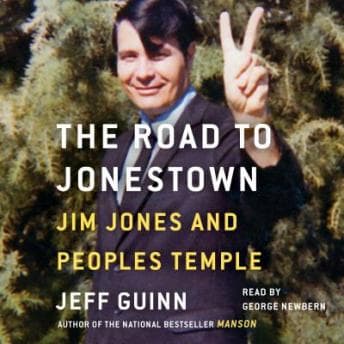

Jim Jones was not born a monster.
That's the thing that sat with me long after the final chapter. I was shelving returns at the library on a quiet Tuesday evening, earbuds in, and Guinn's opening chapters about Jones's childhood in Lynn, Indiana — this lonely kid with a fixation on death and religion, staging funerals for roadkill, preaching to empty rooms — it didn't read like a villain's origin story. It read like a case study in how American systems can incubate something catastrophic when nobody's paying attention. And that's what makes this book genuinely unsettling in ways that most true crime doesn't even attempt.
The Slow Poison of Charisma
Guinn does something here that I deeply respect: he refuses to skip to the massacre. You don't get Guyana until you've sat through decades of buildup. Jones's early ministry in Indianapolis, his genuine (or at least functionally genuine) commitment to racial integration in the 1950s, the way he weaponized progressive ideals — Guinn lays it all out with this meticulous patience that mirrors how cult indoctrination actually works. You understand, hour by hour, how someone could follow this man. How intelligent, caring people — teachers, nurses, activists — could hand over their autonomy. And that understanding is way more disturbing than any slasher novel I've covered on the podcast. The creeping, slow-burn dread Guinn builds here reminds me of what Stephen King does at his best in Night Shift — that same patience with accumulation, the sense that something has been quietly wrong for a very long time before anyone names it.
The book spends serious time on the political machinery Jones built in San Francisco. His relationship with Harvey Milk, with Willie Brown, the way Peoples Temple could mobilize voters overnight — this isn't some fringe backwoods preacher story. Jones was embedded in legitimate political power structures. Guinn's FBI document research surfaces details I hadn't encountered before, like the internal Temple planning documents that show just how calculated the move to Guyana was. This wasn't a snap decision. It was an exit strategy that had been on the table for years.
At seventeen and a half hours, this is a commitment. But Guinn earns every minute. The pacing mirrors Jones's own trajectory — methodical and almost seductive in the early hours, increasingly claustrophobic as the Temple's internal paranoia ratchets up, and then devastatingly swift at the end.
George Newbern and the Art of Restraint
Here's where I want to talk about narration choices, because Newbern makes a smart one: he doesn't perform Jones. There's no Southern preacher voice, no scenery-chewing when reading Jones's increasingly unhinged recorded sermons. Newbern keeps it measured, almost documentary in tone, and that flatness becomes its own kind of horror. When you're listening to descriptions of the "White Night" rehearsal drills — where Jones would wake his followers at 3 AM and tell them enemies were coming, that they all needed to drink poison, and then reveal it was a test — Newbern's steady delivery makes the content hit harder. The narrator commits. That's rare. He trusts the material to do the heavy lifting and steps back.
Is it a flashy performance? No. But this isn't a book that needs flash. It needs credibility, and Newbern delivers that. His reading of the final chapter — the actual events of November 18, 1978 — is controlled in a way that respects the 918 people who died, including nearly 300 children. I appreciated that enormously.
What Haunts After the Headphones Come Off
I listened to the final three hours at home, lights on (I'm not always a masochist), Shirley curled up on the arm of my chair. And what stuck with me wasn't the massacre itself — I've read about that, we all have, the phrase "drinking the Kool-Aid" has been grotesquely absorbed into casual language. What stuck was the testimony from the few who escaped. The people who ran into the jungle in the dark. The ones who'd been trying to leave for months or years and couldn't because their passports had been confiscated, because family members were being held as leverage.
This understands that horror isn't about gore — it's about dread. And the real-world dread here is that Jones's playbook hasn't expired. The mechanisms of control Guinn documents — isolation, sleep deprivation, public humiliation sessions disguised as group therapy, the slow normalization of abuse — they're still operating in organizations right now. Growing up in the kind of religious household I did, I recognized some of those patterns at a bone-deep level. Not at Jonestown's scale, obviously. But the architecture? The emotional logic? Yeah.
Guinn doesn't editorialize much, which is the right call. He presents the evidence, the timeline, the interviews, and lets you sit with it. My podcast listeners are going to love this — it's the kind of source material that generates three episodes of discussion easily.
Who Needs This (and Who Doesn't)
If you're looking for a quick true-crime thrill, this isn't it. At 17+ hours, Guinn is playing the long game, and the payoff requires patience. But if you want to understand how ordinary idealism curdles into something catastrophic — if you want to understand the how and not just the what — this is the definitive account. Skip if detailed descriptions of violence against children (particularly in the final chapters) would be too much. That's not a weakness, that's self-preservation.
Shelve This Under "Essential"
Finally, true crime that respects the genre — and the victims. Guinn wrote the book on Manson. This is better.