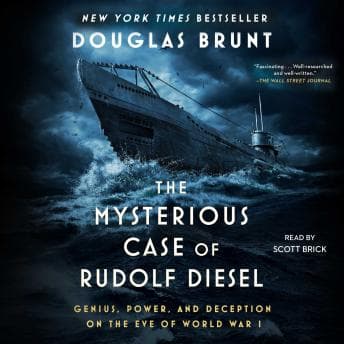

Look, I'll be honest - when someone recommends me a book about an engine inventor, my eyes usually glaze over. I'm a graphic designer who listens to romance novels while adjusting kerning. Technical history is not my wheelhouse. But here I am, having just finished twelve and a half hours about Rudolf Diesel, and I'm genuinely shook.
This book felt like someone took a murder mystery, wrapped it in early 20th-century industrial drama, and somehow made me care deeply about a German engineer I'd never thought about before. Abuela would have loved this one - it's got the telenovela bones she raised me on. Powerful men, betrayal, a mysterious death at sea, and enough conspiracy to fuel a dozen late-night conversations.
The Man Behind the Engine (And Why I Cried)
Okay, I didn't ugly-cry. But I got genuinely emotional, which surprised me. Douglas Brunt does this beautiful thing where he doesn't just give you Diesel's inventions - he gives you his poverty, his dreams, his idealism about making the world better. The man wanted his engine to help farmers and small businesses, not power submarines for the Kaiser. That tension between what he created and what powerful people wanted to do with it? My heart.
There's this through-line about being an outsider, a first-generation success story, that hit different for me. Diesel clawed his way up from nothing in Europe, became world-famous, and then found himself caught between forces way bigger than him. The Kaiser. Rockefeller. These aren't abstract historical figures here - Brunt makes them feel like real threats circling a man who just wanted to build something good.
Scott Brick's Voice Is Low-Key Perfect
I'm usually all about Julia Whelan and the romance narrator queens, so Scott Brick wasn't on my radar. But his gravelly voice works so well for this material. It's like listening to your smart uncle tell you the most fascinating story at a family gathering - steady, confident, with just enough energy to keep you hooked without ever feeling like he's performing.
The pacing is excellent. And I mean that specifically - there are sections dense with technical and political history that could have dragged, but Brick's understated inflection keeps everything moving. I listened at my usual 1.0x (because I'm savoring, not speedrunning, always) and never once felt the urge to skip ahead. That's saying something for a twelve-hour history book.
He doesn't do dramatic voices or anything showy. It's more like... he trusts the material, and that trust comes through. The emotional moments land because he doesn't oversell them.
Where It Gets Dense (But Worth It)
I won't lie - there are stretches where you're getting a lot of information about early combustion engines, oil politics, and German naval ambitions. If you're the type who zones out during the "how stuff works" parts, this might challenge you. I was designing album covers during some of the technical sections and had to rewind a few times.
But here's the thing: Brunt writes like a novelist, not a historian. Even the dense parts serve the mystery. Every detail about who controlled oil, who wanted what engine for which purpose - it all builds toward that night on the steamship Dresden. The vibes are immaculate in a slow-burn, "trust me, this is going somewhere" kind of way.
The Mystery Actually Delivers
I was worried this would be one of those history books that promises a mystery and then just shrugs at the end with "we'll never really know." But Brunt actually commits to a theory. A pretty bold one. Whether you buy it completely or not, it's satisfying in a way that a lot of true crime and historical mysteries aren't.
The final section, where he lays out his conclusion about what happened to Diesel? I was sitting in my apartment, cats judging me, completely absorbed. This is a rainy Sunday book for sure - the kind where you make coffee, curl up, and let yourself get lost in another century.
Who Should Listen (And Who Should Skip)
This is perfect for anyone who loves biography with stakes, history that reads like thriller, or stories about idealistic people crushed by powerful systems. That same tension between individual courage and impossible odds runs through Lone Survivor, though in a completely different context. If you've ever been fascinated by how the world we live in got built - and who got destroyed in the process - this is your book.
Skip it if you need constant action or can't handle information-dense passages. Also maybe not the best workout listen - you want to actually pay attention.
But for my fellow long-listen lovers who want something smart and emotionally engaging? The chemistry between Brunt's storytelling and Brick's narration is chef's kiss. I went in skeptical and came out genuinely moved by a man who died over a hundred years ago. That's the power of a good audiobook.





![Steve Jobs [unabridged audiobook] audiobook cover](/_next/image?url=https%3A%2F%2Fcovers.audiobooks.com%2Fimages%2Fcovers%2Ffull%2F9788499923406.jpg&w=1920&q=75)