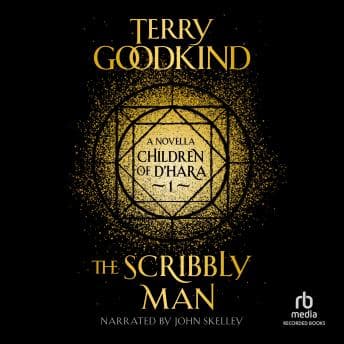
The Scribbly Man has the bones of something genuinely unsettling and then ends before the skeleton is fully assembled.
I'll be honest - I came to this knowing exactly what I was getting into. Terry Goodkind's Sword of Truth series was never really my corner of the fantasy world (I'm more of a "psychological dread seeping through the walls" person than a "chosen hero with a magic sword" person), but that description? Kahlan talking about shapes caught in peripheral vision, shadows that solidify when you're afraid enough? That's horror language. That's my language. So I grabbed this one on a late shift at the library, after closing, with the lights already dimming on a timer because our branch is old and weird and the electrical system has opinions.
Perfect setting. The book almost earned it.
The Dread That Almost Was
Here's what works: Goodkind understands - or at least understood, in this particular novella - that the scariest monsters are the ones you can't fully see. The titular Scribbly Man concept taps into something primal. The idea that these entities have always been on the periphery of human perception, glimpsed but never fully present, and that a cosmic shift has now given them the ability to cross over and do real damage? That's a premise I'd build an entire podcast episode around. It's Shirley Jackson's "no live organism can continue for long to exist sanely under conditions of absolute reality" filtered through epic fantasy, and I was genuinely leaning forward during the setup.
But here's the thing about a 3-hour-51-minute novella that's actually the first installment of a serialized story: it doesn't get to finish what it starts. The dread builds, the concept lands, and then you're staring at the end credits like someone yanked the last 30 pages out of a book. Multiple listeners have described it as "finishing as soon as it got started," and they're not wrong. The Scribbly Man creatures deserved a slow, suffocating reveal. Instead they get a setup chapter sold at novel prices.
John Skelley Steps Into Big Shoes
Long-time Sword of Truth audiobook listeners apparently have strong feelings about the previous narrator, Sam Tsoutsouvas. Skelley is stepping into that shadow, and to his credit, he doesn't try to replicate what came before. His voice carries authority - particularly when channeling Richard's decisiveness and Kahlan's measured intensity. He conveys their relationship as equals without overselling it, which is a harder balance than it sounds.
But - and this matters for a story about creeping supernatural terror - the narrator commits to competence more than atmosphere. There's a difference between reading horror and performing it. The passages describing the Scribbly Man's nature, the way they exist at the edge of sight, needed a vocal shift. A drop. A hesitation that makes you feel the character's fear in your own chest. Skelley reads it straight. Professionally. Pleasantly. And for this particular story, "pleasant" is almost the opposite of what I needed. The man's voice isn't unpleasant - that's actually one of the nicest things listeners say about him - but "not cringe-worthy" is a low bar when your subject matter is existential shadow entities.
I wanted the narrator to make me feel what Kahlan describes. I got a solid read instead.
The Installment Problem (Let's Talk About It)
I can separate "is this a good story" from "is this a good product," and those are two very different questions here. As a story fragment, The Scribbly Man introduces a creepy concept within an established world and moves pieces into position for what could be a genuinely frightening arc. As a standalone audiobook purchase? Under four hours, ending on what amounts to a chapter break, sold at the same price as books three times its length? That's a hard sell. Literally.
Goodkind was apparently releasing the Children of D'Hara series as serialized novellas, and I get the business model, but it means each piece has to justify its own existence. This one introduces more than it resolves. For existing fans deep in the Sword of Truth universe, that might be fine - you're buying continuation, not conclusion. For someone like me, approaching it for the horror elements in that gorgeous description? It's a trailer for a movie I'd have to buy four more tickets to finish watching.
Who Gets the Most Out of This
If you're already invested in Richard and Kahlan's world, this is a quick return visit that plants seeds for something darker than Goodkind's usual fare. Grab it. If you're a horror listener drawn in by the premise - the shadow creatures, the peripheral terror, the cosmic shift - know that you're getting the appetizer and the entrée requires separate purchases. If you scare easily, this won't test you. The concept is scarier than the execution. That gap between concept and execution is something I kept thinking about with Witch's Heart too — a premise drenched in mythological dread that actually follows through on its atmospheric promises in ways this one simply doesn't.
I listened in the stacks after hours. The building creaked. Shirley (my cat, not Jackson) wasn't there to judge me, but the empty library did the job. And for about forty minutes in the middle, when Goodkind was laying out what the Scribbly Man actually is, I felt something. A prickle. The good kind.
Then it ended, and the prickle went with it.
Finally - horror that almost respects the genre, then runs out of pages.