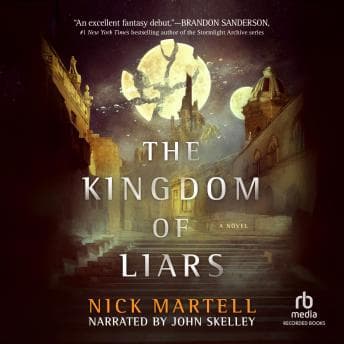

I was three hours deep into what was supposed to be a productive coding session when I realized I hadn't written a single line of actual thesis work. Kingdom of Liars had me completely hooked, and honestly? No regrets. Dr. Patel can wait. This book scratches an itch I didn't know I had.
Memory as Currency - Finally, a Magic System That Makes Sense
Okay, so here's the thing about fantasy magic systems: most of them are either too vague (looking at you, soft magic) or too complicated for their own good. Nick Martell hits this sweet spot where magic costs you your memories to use. Not just any memories - specific ones. The more powerful the magic, the more you lose. This is Sanderson-level world-building in terms of internal consistency, and my D&D group would absolutely steal this for a campaign. Chosen of the Manifold has that same kind of systematic magic that makes you want to reverse-engineer the rules.
Michael Kingman is essentially a disgraced noble's son trying to clear his family name while navigating a kingdom that's falling apart at the seams. There's this whole political structure with gun-wielding rebels fighting against magical militia, and the worldbuilding unfolds at a pace that rewards attention. If you don't like info-dumps, this isn't for you (but you're wrong). The Hollows feels lived-in, with its own history and conflicts that extend beyond just what Michael can see.
The mystery at the core - what actually happened with Michael's father and the murdered prince - kept me guessing longer than I expected. There's something in Michael's missing memories that holds the key, which is a clever narrative trick. The protagonist literally can't remember crucial plot information, and neither can we.
John Skelley's Voice Work: A Mixed Bag
John Skelley is... fine. I want to be fair here because he clearly puts effort into the performance, and there's genuine warmth in how he approaches Michael's internal struggles. But here's my honest take: the dude has maybe 3-4 distinct voices, and he uses them for everyone. Male characters. Female characters. Different nationalities. All sound like slight variations of the same guy.
I found myself rewinding more than once because I genuinely couldn't tell who was speaking in group conversations. When Michael's talking to his siblings or meeting with various political players, it becomes this guessing game of "wait, was that the rebel leader or the noble?" Not ideal when you're trying to follow political intrigue.
Compare this to Tim Gerard Reynolds doing Red Rising or Steven Pacey's work on First Law - those narrators create such distinct character voices that you could close your eyes and instantly know who's talking. Steven Pacey walked so other narrators could run, and Skelley... he's still learning to crawl in that department. It's not bad enough to ruin the experience, but it does require more active listening than I'd like.
Debut Energy (The Good and The Rough)
You can tell this is Martell's first book. That's not entirely a criticism - there's an enthusiasm here, a willingness to throw ideas at the wall, that feels refreshing. The progression is satisfying as Michael slowly pieces together his past and gains allies. But some of the twists land with less impact than they should, partly because the setup isn't always as tight as it could be.
The rebels-vs-magic-users conflict has real potential, and the class dynamics remind me of Red Rising's Gold/Red divide (though less brutal). Shine explores similar power imbalances, though it takes a completely different approach to the magic-as-privilege angle. There's commentary on power and who gets to wield it that feels relevant without being preachy.
At nearly 16 hours, this is a commitment. Yes, it's worth it - mostly. The middle section drags slightly, and I'd recommend 1.25x speed if you're comfortable with that. Helps with pacing and honestly makes some of the voice similarity issues less noticeable since you're processing faster.
Who's Rolling Initiative on This One
This is for fantasy readers who want their world-building dense and their magic systems logical. If you loved Mistborn's allomancy or The Name of the Wind's sympathy magic, the memory-based system here will scratch that same itch. LitRPG fans who appreciate clear rules and costs will dig it too.
Skip if: you need crystal-clear narrator differentiation, you're looking for something light, or you don't have patience for political setup. This is setup for a series, so expect some threads left dangling.
Worth Rolling the Dice?
Kingdom of Liars is a promising debut with a genuinely creative magic system and a mystery that kept me engaged through my entire procrastination session. The narration holds it back from greatness - I'd honestly consider the print version if audio clarity matters to you. But the story itself? My D&D group would love this. I'm already planning to steal the memory-magic concept for our next campaign.
Now if you'll excuse me, I have approximately 47 pages of thesis I should probably write. (I'm going to start the sequel instead.)