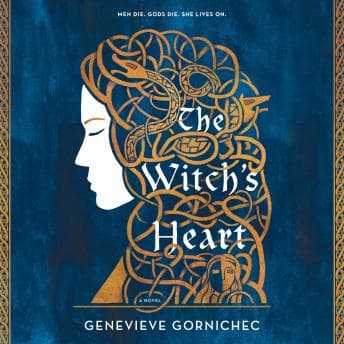

What happens when a woman's story begins where it's supposed to end?
I was grading a stack of mythology essays at 11PM - the ones where students confuse Thor with Zeus and call Loki "the villain from the Marvel movies" - when Angrboda's voice cut through my red-pen frustration. Here's a character my students have never heard of, the mother of monsters, the witch who loved the trickster god, and she's been waiting in the margins of the Eddas for a thousand years for someone to tell her story properly.
Genevieve Gornichec finally did.
The Classics Teacher's Dilemma (Or: Why I Teach Mythology Wrong)
I've spent two decades teaching the hero's journey. Odysseus gets home. Beowulf slays the monster. The protagonist acts, and the world responds. But The Witch's Heart asks a question I've never quite put to my students: What about the women who watch? Who wait? Who see the future coming and can't stop it?
Angrboda is a seeress. She knows what's coming for her children - Fenrir the wolf, Jörmungandr the serpent, Hel the half-dead queen. She knows Ragnarök approaches. And she loves them anyway, raises them anyway, at the edge of the world where Odin's eye can't reach. This is what Hemingway called "grace under pressure," except Hemingway never wrote about a mother watching her children get dragged away by gods.
The prose deserves to be savored. Gornichec writes with the patience of the sagas themselves - long winters, slow seasons, the accumulation of centuries. My students would hate this. I love it.
Entwistle's Northern Lilt (And the Accent Question)
Let's talk about the elephant in the longhouse: Jayne Entwistle performs Norse gods with a Northern English accent. Some listeners found this distracting. I found it - after the first hour - exactly right.
Here's my thinking. We don't actually know how Old Norse sounded. We're all guessing. And Entwistle's husky, sage delivery gives Angrboda a groundedness that a more theatrical approach would've ruined. When she shifts to Loki - that mercurial, unreliable, desperately lovable trickster - there's an edge that creeps in. You hear why Angrboda falls for him. You also hear why you shouldn't trust him.
The tender moments with the children nearly broke me. Entwistle finds this maternal fierceness that's protective and terrified at once. And when Skadi enters - the huntress, the warrior, the woman who becomes something more than friend to Angrboda - there's a warmth that builds so gradually you don't notice it until it's already happened.
If you loved the quiet intensity of Circe, this is its spiritual successor. Same energy. Different pantheon. Equally devastating. Raven Boys has that same slow-build magic, where atmosphere matters more than plot velocity.
The Slow Burn That Earns Its Fire
I'll be honest: this book takes its time. Twelve hours of deliberate pacing. Some listeners speed it up to 1.5x or 1.6x. I listened at 1.0x because the author chose those words, chose those silences, and the narrator understands that pause is punctuation.
But I won't pretend it's for everyone. If you need plot momentum, if you want action beats every chapter, this will frustrate you. The story spans centuries. Relationships develop across decades. Angrboda spends long stretches alone in the Ironwood, recovering, remembering, waiting.
This is why we still read the classics - because patience rewards. The final third, when prophecy becomes reality, when Angrboda must choose between acceptance and rebellion - worth pausing the faculty meeting for. (Sorry, Principal Martinez. I definitely wasn't listening during your facilities update.)
Who Should Wander Into the Ironwood (And Who Should Stay Home)
This is for readers who want mythology from the margins. Who've read the Norse tales and wondered about the women barely mentioned. Who don't mind spending twelve hours with a protagonist who watches more than she acts - until she doesn't.
Skip it if you need constant forward momentum, if English accents for Nordic characters will pull you out, or if you're looking for the Loki from the movies. This Loki is older, stranger, more human in his divinity.
Content note: there's violence, some sexual content, and the kind of abuse that comes wrapped in divine authority. Odin is not a nice god here.
The Kind of Book You Finish in Silence
Denise and I finished this on a Sunday morning, walking the lakefront, and I didn't say anything for a while after. That's the test, isn't it? When a book leaves you quiet.
Gornichec has written a debut that feels like it's been waiting to be told for a millennium. Entwistle's narration shaped how I imagined Angrboda - husky, wise, wounded but not broken. The AudioFile Earphones Award and Audies nomination make sense.
I'm adding this to my mythology unit next semester. My students will probably hate it. But maybe one of them will hear what I heard: a woman's voice, finally, from the edge of the world.