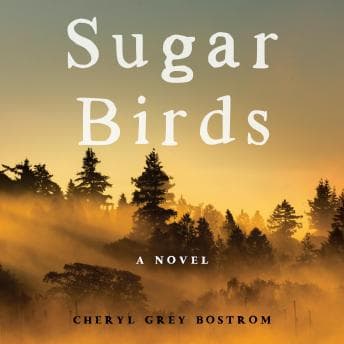

Look, I'll be honest. When I see a book with a laundry list of "Inspirational" and "Christian Fiction" awards, I usually run the other way. Fast.
It's not that I'm anti-spiritual—I teach Faulkner, so I deal with plenty of biblical allegory—but the genre often feels... sanitized. Like cafeteria sheet cake. Sweet, safe, and completely forgettable. So when I picked up Sugar Birds, I was fully prepared to roll my eyes and switch back to my tenth relisten of Moby Dick. (Yes, I have a Moby Dick problem—we can unpack that another time.)
I didn't switch back.
This isn't a sermon disguised as a novel. It's a raw, messy dive into the Pacific Northwest wilderness that feels more like Where the Crawdads Sing than a Sunday School lesson. (Though, let's be real, Crawdads had its issues too, but that's a rant for another podcast episode.)
Jayne Entwistle's Bold Performance
Let's talk about Jayne Entwistle.
I did a little digging before writing this, and I saw some folks online complaining that her accent is "too strong" or "grating." Hard disagree.
Here's the thing about audiobooks: we claim we want distinct characters, but the second a narrator makes a bold choice, people panic. Entwistle doesn't just read; she performs. She's narrating a story about a 10-year-old girl (Aggie) who accidentally lights a fire and hides in the woods, and a teenage girl (Celia) running from family trauma. These are intense, emotional perspectives.
If Entwistle sounded like a generic GPS voice, this book would fall flat. Instead, she leans into the quirks. Yes, it's stylized. But it works. She captures that specific, frantic energy of a child trying to survive her own mistakes. There were moments while I was grading essays—red pen in hand, despair in my heart—where her voice actually made me stop and stare at the wall. She nails the vulnerability.
(Though I will admit, if you're used to very flat, American narration, it might take you a chapter to adjust. Give it twenty minutes. It clicks.)
Walking Through the Woods at Bostrom's Pace
Now, about the pacing.
If you're looking for a thriller where something explodes every four pages, you're in the wrong place. Go buy a Jack Reacher novel. (No shade, I read those on planes.)
Sugar Birds is atmospheric. That's teacher-speak for "slow."
The author, Cheryl Grey Bostrom, clearly loves nature. Like, really loves it. She spends time on the moss, the trees, the birds. Some reviews called this "dull." I call it "breathing room." We spend so much time rushing—especially my students, who think a 15-second TikTok is a documentary—that we forget how to just sit in a setting.
The tension here isn't about car chases. It's about survival and the internal guilt eating these characters alive. The dual timeline between Aggie and Celia weaves together slowly. There were moments in the middle where I checked the timestamp and thought, "Okay, are we getting there?" But then the prose would pull a move that reminded me why I love literary fiction.
It's a specific vibe. You have to be willing to walk through the woods at the author's pace, not yours.
Who's This For (And Who Should Skip It)
If you loved the nature writing in The Great Alone but wanted something a little less depressing, this is your jam. Readers who need constant plot momentum will get restless—go grab that Jack Reacher instead. And if heavy-handed religious messaging is your concern, relax: the spiritual themes here feel organic to the story, woven into the landscape rather than preached at you.
Red Pen Down, Coffee Cold
The "Christian" label? It's there in the themes—forgiveness, redemption, the idea of a Creator in nature—but it's not beating you over the head with a bible. It feels organic to the story, not pasted on.
Is it perfect? No. The dialogue sometimes feels a little too polished for kids in 1985. But the atmosphere is killer. It made me want to go outside and actually look at a bird, which is saying something since I usually only see pigeons fighting over Cheetos near the faculty parking lot.
Just be patient with the start.