
"Venture to the Hadeshorn."
That line hit me somewhere around hour three, while I was sitting in my apartment surrounded by a truly embarrassing number of unfinished board game campaigns, pretending I was about to open my thesis document. I did not open my thesis document. I listened to the next four hours instead.
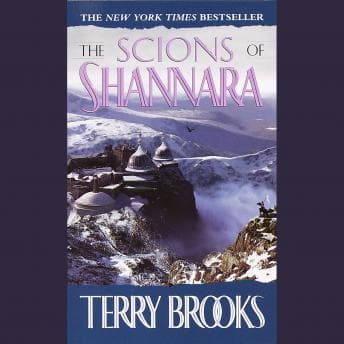
Here's the thing about Scions of Shannara — it's a book that shouldn't work as well as it does in 2024. Terry Brooks wrote this in 1990, and the DNA is very much classic quest fantasy. You've got your reluctant hero with a magical gift he doesn't fully understand, a cryptic dead wizard issuing commands from beyond the grave, and a MacGuffin sword that needs recovering. If I described this to my D&D group, half of them would say "so it's your last campaign." And they wouldn't be wrong. But Brooks does something here that earns its nearly eighteen hours: he builds a Four Lands that actually feels like it changed between series. The Southland is under totalitarian rule. Magic is banned. The Federation has turned the world into something that feels less Tolkien and more dystopian, and that friction between high fantasy tropes and political oppression gives the whole thing a weight that the original Shannara books didn't have.
The World After the Druids Fell
What grabbed me most is the setup — the idea that the age of Druids and magic didn't just fade, it was actively suppressed. Par Ohmsford still has the Wishsong, and the moment early on where he accidentally conjures a mythic horror to life is genuinely unsettling. Brooks doesn't rush past it. You sit in that dread with Par, and then Cogline shows up like some grizzled NPC your DM improvised at the last second, and suddenly the quest hooks are flying. The Hadeshorn sequences have this dark, almost Ravenloft-adjacent energy — dead spirits rising from black water, Allanon's shade issuing prophecies that feel more like threats. If you don't like info-dumps, this isn't for you (but you're wrong). Brooks layers the lore thick, and the payoff is a world that feels lived-in rather than assembled.
The progression is satisfying, too. Par's not some chosen one who instantly levels up. He's fumbling through a world that doesn't want him to have power, surrounded by people who are either hunting him or don't believe the old magic matters anymore. The multiple POV structure — following Par, Walker Boh, and Wren on their separate threads — gives the book that epic campaign feel where the party splits and you're cutting between storylines. My D&D group would love this.
John Lee: The Narrator Debate
Okay. John Lee. This is where things get divisive and I need to be honest.
John Lee is an Audie Award winner. He knows what he's doing. His voice has this deep, authoritative quality that works beautifully for the narration passages — the descriptions of the Hadeshorn, the political tension in the Southland, the weight of Allanon's commands. When he's setting atmosphere, he's locked in.
But — and I say this as someone who considers Steven Pacey a god among narrators — Lee's character work is inconsistent. He does differentiate voices, and Par's earnestness comes through clearly distinct from Walker Boh's brooding gravitas. That part works. Where it stumbles is pacing. There are stretches in the middle third where Brooks is doing necessary but slower connective tissue (travel sequences, political exposition), and Lee reads them at the same measured cadence as the action beats. It can feel... flat. One reviewer compared it to Captain Kirk's halting delivery, and while that's harsh, I get where they're coming from. During the quieter chapters around hours 8-12, I bumped it to 1.25x and it honestly improved the experience.
He's not bad. He's just not going to make you forget about the page when things slow down. Steven Pacey walked so other narrators could run, and Lee is... walking at a respectable pace.
This Is Sanderson-Level World-Building (From a Different Era)
Look, the magic system isn't going to satisfy you if you need Sanderson-level hard rules. The Wishsong operates on vibes and narrative necessity more than defined constraints. But the political world-building? The way Brooks constructs the Federation's grip on the Southland, the way magic users are persecuted, the paranoia that infects even the characters who should be allies — this is Sanderson-level world-building in its ambition, just executed through a different lens. Brooks is painting a world where the old stories are dying, and the question isn't just "can they find the Sword" but "does anyone still believe in what it represents."
I read this instead of writing my thesis. Dr. Patel would not approve. But honestly, the thematic stuff about legacy and whether the next generation can live up to what came before? Hitting a little too close to home for a grad student on his fourth year.
Who Gets a Seat at This Table
If you grew up on Shannara and dropped off — this is where Brooks found his stride. Fans who bounced off the original trilogy's Tolkien-adjacent simplicity will find something meatier here. It's 17 hours 45 minutes. Yes, it's worth it. But go in knowing the pacing is a slow burn, especially through the middle. Bump the speed if Lee's cadence starts dragging for you.
If you need fast action and tight plotting, this will test your patience. If you want a world that rewards attention and a quest structure that feels like a proper campaign arc — pull up a chair.
Roll for Initiative on Your Next Credit
It's not perfect. The pacing sags, Lee's narration could use more dynamic range in the quieter stretches, and Brooks occasionally over-explains things he's already shown you. But the bones of this story are strong, the world feels genuinely different from the earlier Shannara books, and Par's journey from reluctant magic user to someone who has to reckon with an impossible destiny? That's the good stuff. That's why we listen to eighteen-hour fantasy audiobooks instead of finishing our theses.