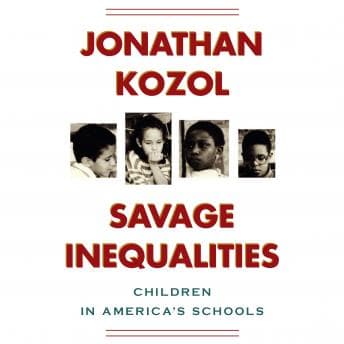

"The children in East St. Louis live surrounded by sewage."
I was chopping onions for dal when that line hit me around the forty-minute mark. And I just... stopped. Knife in hand, tears already forming (the onions, sure, but also not just the onions). Kozol doesn't ease you into this. He drops you into a school where raw sewage backs up into the cafeteria, where children learn to navigate around it like it's just another obstacle in their education. Which, of course, it is.
Kozol's Righteous Fury as Research Method
Kozol spent two years visiting schools across America in the late '80s, and what he documented is a case study in institutional neglect so systematic it would make any social psychologist's head spin. Funding disparities between wealthy and poor districts can exceed 2:1 ratios—but hearing it quantified is different from hearing a child in the South Bronx describe their school as "a place where you go to wait." Wait for what? Kozol never explicitly asks, but the answer hangs there: wait to be forgotten.
What makes this book compelling is Kozol's refusal to treat these children as statistics. He gives us their names, their aspirations, their devastatingly clear-eyed assessments of their own circumstances. A teenager who knows exactly why her school has no AP classes. A principal who can calculate, to the dollar, how much less his students are worth in the state funding formula. The pattern here isn't just economic—it's a collective psychological adaptation to being told, repeatedly and structurally, that you matter less.
When the Messenger Undermines the Message
Here's where I have to be honest about the audio experience, because it's... complicated. Mark Winston reads this material with what I can only describe as public radio neutrality. Cool. Measured. Professional. For the first hour or two, I thought: okay, maybe this restraint is intentional, a counterbalance to Kozol's impassioned prose.
But by hour five? It becomes numbing. Kozol writes with urgency—his sentences practically vibrate with barely contained outrage—and Winston delivers them like he's reading a particularly interesting municipal budget report. The disconnect is jarring. You're hearing about children who don't have textbooks, who share single toilets among hundreds of students, and the voice in your ear sounds like it's describing traffic patterns.
And then there's the music. Every time a tape change occurs (yes, this is clearly an older production), there's this musical cue that feels almost jaunty? Inappropriate doesn't quite cover it. My therapist would have thoughts about whoever made that production choice.
The Repetition Is the Point
The repetition that some listeners find exhausting? I kept asking myself: why does Kozol hammer the same points across different cities? I think it's intentional. He's not just documenting inequality—he's building a prosecutorial case. Each city is another exhibit. East St. Louis, then Camden, then the South Bronx, then San Antonio. Same patterns. Same neglect. Same children paying the price.
This is a fascinating case study in how we compartmentalize systemic failure. Kozol interviews well-meaning white suburban parents who genuinely believe their schools are "good" because of something inherent, not because they're spending three times as much per pupil. The cognitive dissonance he captures—people who consider themselves progressive while actively opposing any redistribution of educational resources—is uncomfortable precisely because it's so recognizable. That kind of self-protective rationalization shows up differently in Wired for Love, where Stan Tatkin breaks down how our brains construct narratives to avoid uncomfortable truths about our own behavior in relationships.
The book is from 1991. I listened to it in 2024. The fact that almost nothing has fundamentally changed might be the most damning indictment of all.
Take It In Doses (Seriously)
I couldn't do this in long stretches. Two hours maximum before I needed to step away, cook something, call my mother, remind myself that human beings are capable of care and not just systematic abandonment. The content is heavy—not in a manipulative way, but in an honest one. These are real children. Real schools. Real choices made by real adults who decided, collectively, that some kids deserve less.
Kozol knows exactly how to present a child's face, a child's words, in a way that makes the abstract concrete. You can't unhear a six-year-old explaining why she thinks she's "not worth much" to the government.
Winston's narration doesn't ruin the experience, but it doesn't elevate it either. For material this important, that feels like a missed opportunity. Still, the content itself—Kozol's actual reporting and analysis—remains essential. National Book Award winner for a reason.
Who This Is (and Isn't) For
If you work in education, policy, or social services—or if you've ever wondered why "just work harder" rings hollow for some kids—this is required listening. Skip it if you need solutions alongside your problems; Kozol diagnoses brilliantly but doesn't prescribe. Also skip if flat narration will make you throw your phone.
The Diagnosis Stands
Just maybe keep the tissues handy. And the onions optional.