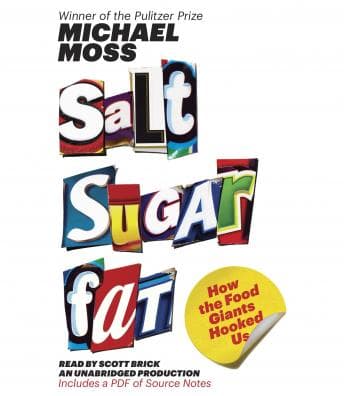

How much would you pay to understand why you can't stop eating Doritos at 11 PM? Because I just spent 14 hours finding out, and honestly? Worth every minute.
I was prepping for a client pitch on food and beverage strategy when I started this one. By hour three, I'd texted my analyst to add "regulatory risk" to every slide. By hour seven, I was standing in my kitchen, reading ingredient labels like a conspiracy theorist. Jenny walked in, saw me holding a box of Wheat Thins with genuine betrayal in my eyes, and just backed out slowly.
The ROI on Your Outrage
Bottom line: Michael Moss delivers investigative journalism that actually respects your intelligence. This isn't some preachy documentary narrator telling you processed food is bad. You know that. I know that. My parents knew that while selling dry cleaning chemicals all day and still cooking Korean food from scratch every night because they didn't trust anything in a box.
What Moss gives you is the how. The "bliss point" - that's the precise amount of sugar where your brain lights up like a slot machine hitting jackpot. Food scientists calculate this to the decimal point. They're not guessing. They're engineering addiction with the same rigor my McKinsey colleagues used to optimize supply chains. Except the supply chain here is your dopamine system.
The 1999 secret meeting at Pillsbury headquarters? That's your opening scene, and it's devastating. A Kraft executive stands up, basically says "we're creating a health crisis and lawyers are coming," and the General Mills CEO shuts him down. Meeting over. Back to business. I've been in rooms like that. The dynamics Moss describes - the willful blindness, the quarterly earnings pressure overriding everything else - it's depressingly accurate.
Scott Brick: Authoritative or Exhausting?
Here's where it gets interesting. Scott Brick is a narrator who people either love or can't stand, and after 14 hours, I get both sides. His voice has this authoritative, almost documentary quality that works brilliantly for the investigative sections. When he's walking you through the chemical manipulation of "mouthfeel" or explaining how Lunchables became a $1 billion brand by marketing to kids' desire for autonomy, he's exactly what you want.
But - and this is a real but - he can feel relentless. No vocal variety for different executives or scientists. Everyone sounds like they're testifying before Congress. For a 14-hour listen, that's a lot of the same register. I bumped to 1.5x around hour six, which helped. At 2.0x (my usual speed), some of the data-dense sections became a blur.
One listener called it "difficult to listen to," and I wouldn't go that far. But if you're hoping for distinct character voices? That's not this. Brick treats the material like a legal brief - thorough, clear, and utterly serious. For investigative journalism, probably the right call. For your third hour on the treadmill, maybe less ideal.
What My Parents Knew Without a Pulitzer Prize
The section on salt hit different. Moss explains how the food industry uses salt not just for flavor but as a preservative, a texture modifier, and a mask for the chemical aftertaste of processed ingredients. Without salt, most processed food would be literally inedible. The industry is trapped - they can't reduce salt without their products tasting like cardboard. The same kind of industrial engineering shows up in 100 Ways to Overcome Shyness, except there it's emotional manipulation instead of chemical—both designed to keep you coming back.
My parents never bought processed food. Not because they read studies, but because they grew up in post-war Korea where you made everything from scratch or you didn't eat. They'd look at a Lunchable and see what Moss spends three chapters explaining: it's not food, it's an engineering project. My mom would've just called it "American nonsense" and moved on.
The Billable Hours Breakdown
The first seven hours are worth the listen - the remaining seven on industry history and regulatory failures are bonus material for policy wonks and food industry professionals. If you're just trying to understand why you can't stop at one Oreo, you'll have your answer by hour five. The "heavy users" concept alone (that's what food companies call their most addicted customers, by the way) will change how you read marketing forever.
Skip to chapter 5 if you want the psychology fast. But honestly, the buildup is part of what makes this effective. Moss earns his outrage with evidence.
Who Gets the Invoice (And Who Doesn't)
Perfect for: Anyone in food/beverage strategy, health policy, or who just wants to understand the machine. Also excellent for parents wondering why their kids are obsessed with certain snacks - spoiler, it's not an accident.
Skip if: You want entertainment over education, or if a single narrator for 14 hours sounds exhausting. This is a focused listen, not background noise.
Jenny would say I'm being harsh about Brick's narration. Jenny is right - he's competent and clear. But at 14 hours, "competent and clear" starts to feel like a long conference call. Worth it for the content. Just maybe not in one week like I did.