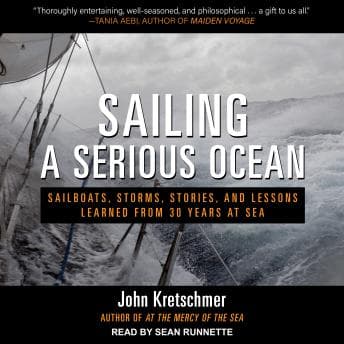

"The ocean doesn't care about you." Kretschmer doesn't say it quite that bluntly, but around hour three, somewhere in a passage about a storm off the coast of South Africa, that's the feeling that punched me in the chest. I was up at 2 AM finishing a logo redesign for a client who keeps changing their mind about fonts, and this man is describing waves taller than buildings with the calm of someone ordering coffee. And I just... sat there. Forgot about the kerning entirely.
Let me be honest: I picked this book up on a whim. I have never sailed anything larger than a kayak on Lady Bird Lake. I don't know port from starboard without Googling it. But someone recommended it as a great memoir disguised as a sailing manual, and I'm a sucker for people who are obsessed with something - truly, deeply, irrationally obsessed - because that kind of love always translates, even when the subject matter is nautical charts and hull designs.
The Man Who Talks to Storms Like Old Friends
Kretschmer has this way of writing about terrifying situations - genuinely life-threatening ocean crossings - with a warmth that makes you feel like you're sitting across from him at a bar and he's had exactly two beers. Not sloppy, not showing off. Just honest. Sean Runnette's narration leans into that energy. His voice has this grounded, steady quality that works beautifully for the storm sequences because he doesn't oversell the danger. When Kretschmer describes being knocked down in the North Atlantic, Runnette reads it with the same measured weight the author clearly intended - the terror is in the facts, not the delivery.
But here's where it gets complicated. Kretschmer's boat - Quetzal - is basically a character in this book. She's the vessel, the companion, the thing he trusts with his life. And Runnette pronounces her name differently at least a couple of times throughout the listen. Once you notice it, you can't un-notice it. It's like someone mispronouncing your best friend's name at their wedding. It didn't ruin anything for me, but it pulled me out of moments that should have been sacred.
Technical Chapters That Somehow Made Me Emotional?
Okay, so there are sections about gear selection. Route planning. How to choose a bluewater boat. On paper, this should have been background noise while I worked. But Kretschmer weaves his philosophy of life into every technical discussion. When he talks about choosing a smaller, simpler boat over a flashy one, he's really talking about humility. About knowing your limits. About how the ocean will expose every lie you've told yourself.
My abuela used to say something similar about cooking - "No le pongas más de lo que necesita." Don't add more than it needs. Kretschmer's whole sailing philosophy is that. Strip it down. Know what matters. Respect what's bigger than you.
Abuela would have loved this one. Not the sailing parts - she got seasick on the River Walk boat tour in San Antonio - but the way this man talks about respect. For the water, for the craft, for the people who came before him. That she would have understood in her bones.
Runnette's Voice Is a Steady Hand on the Wheel
Sean Runnette doesn't do flashy. He's not Julia Whelan (nobody is, let's be real), but for this material he's the right choice. His tone is strong and unhurried - the kind of voice that would actually be calming during a storm. He handles the shift between storytelling and instruction without making the technical parts feel like a textbook, which is a real skill. There's a gentleness in his delivery during the passages where Kretschmer reflects on why he sails, on what the ocean has cost him and given him, that genuinely moved me.
I didn't ugly-cry. Let me be clear. But around hour seven, during a passage about coming into port after a brutal crossing, my eyes got hot and I had to put Diego down off my lap because I didn't want cat fur sticking to my wet face. This book felt like standing on a cliff and understanding, really understanding, that the world is enormous and indifferent and beautiful all at once.
The pronunciation issue with Quetzal is the one consistent flaw, and honestly, as a Mexican-American woman, it stung a little extra. That's a Nahuatl word. It matters. But it's not enough to sink the ship. (Sorry. Had to.)
Who This Is For (And Who Should Steer Clear)
If you need plot-driven tension, skip it. This is a meandering, meditative listen - the kind of book where you look up and realize two hours passed and you feel quieter inside. Sailors will love the technical depth. Non-sailors like me will love the philosophy. If you want constant action or can't handle chapters about rigging, this will test your patience. Listen at 1.0x. Savor it. The vibes are immaculate if you let them be.
My Anchor's Down on This One
This book felt like a long exhale. Like sitting on the dock at dusk and not needing to say anything to anyone. It's not perfect - the Quetzal mispronunciation is a real scratch on an otherwise clean hull, and some technical stretches run long even for a patient listener. But Kretschmer's voice (through Runnette) carries a quiet authority and tenderness that earns every minute of its ten-and-a-half hours. I came for a memoir and left wanting to learn to sail. That's the highest compliment I can give a book about something I know nothing about. The last time a book pulled off that same trick - making me genuinely care about a world I've never touched - was Business Adventures, which somehow made me feel the heartbeat of mid-century Wall Street deals the way Kretschmer makes me feel the Atlantic in my chest.