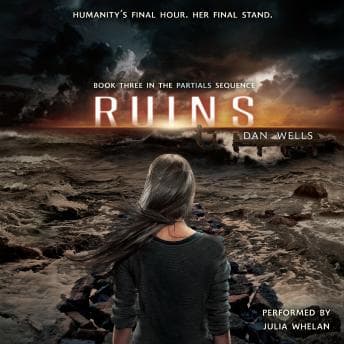

Everyone kept telling me the Partials Sequence was "like Hunger Games but smarter" and I kept nodding politely while internally rolling my eyes. Dystopian YA with bioengineered supersoldiers? Sure, buddy. I've been burned before.
I was wrong. My thesis remains unwritten, and I regret nothing.
The Magic System Is Actually Science (And It's *Chef's Kiss*)
Look, I know this is technically science fiction, but Dan Wells builds his Partial biology the way Sanderson builds magic systems. There are RULES. The link pheromones, the expiration dates coded into Partial DNA, the way RM virus interacts with both species—it all clicks together like a really satisfying puzzle box. By the time you hit Ruins, you understand exactly why both sides are terrified of each other, and more importantly, why they're both kind of right to be.
The whole human-Partial dynamic hits different when you realize Wells isn't doing a simple "robots bad" or "humans bad" story. He's doing something way messier. Kira's caught between two species that could save each other but might destroy each other first, and the tragedy is that everyone's making rational decisions based on their own survival. It's the kind of world-building that makes you pause the audiobook to explain the political factions to your roommate. (My roommate has started wearing headphones when I come home. Correlation unclear.)
Julia Whelan Does the Impossible With Emotionally Muted Supersoldiers
Okay, I need to talk about Whelan's performance because she's doing something sneaky here. The Partials are supposed to be emotionally muted—they communicate partly through pheromones, so their verbal expression is deliberately flatter. A lesser narrator would've made them sound robotic and boring. Whelan threads this needle where Samm sounds controlled but not dead, and you can hear the moments when emotion breaks through that control. It's subtle work.
Her Kira is the anchor though. This is a character who's been through absolute hell across three books, and Whelan layers in this exhaustion and determination that builds across the series. By Ruins, Kira sounds like someone who's stopped asking "will I survive this" and started asking "what am I willing to sacrifice." That's character work, people.
The action sequences land too. There's a lot of military movement in this book—factions positioning, ambushes, desperate last stands—and Whelan keeps the tension wound tight without going full melodrama. When things go wrong (and things go VERY wrong), you feel it.
Twelve Hours of "Just One More Chapter" Syndrome
Here's where I'll be honest: some folks find the pacing slow in places. There's a lot of world-building, a lot of political maneuvering, a lot of characters explaining their positions to each other. If you need constant action, this might test your patience.
But here's the thing—I listened to this during a marathon thesis-avoidance session (Dr. Patel, if you're reading this, I was "doing research on narrative structure") and the slower sections never lost me. Wells uses those quieter moments to build dread. You know the war is coming. You know it's going to be ugly. The buildup makes the payoff hit harder.
At 12 hours and 40 minutes, this is a commitment, but it's the final book in a trilogy. You're not here for a quick read. You're here to see how it ends. And Wells delivers an ending that feels earned—not a cop-out, not a deus ex machina, but a conclusion that costs something. My D&D group would appreciate the stakes here. Real consequences, real sacrifice, no resurrections.
The "Both Sides Have a Point" Problem
What I keep thinking about days later is how Wells handles the moral complexity. The Partials aren't villains. The humans aren't heroes. Everyone's trying to survive, and survival means different things to different factions. There's a moment—I won't spoil it—where a character makes a choice that's objectively terrible but completely understandable given what they know, and I actually said "oh no" out loud. In my apartment. Alone. At 2 AM.
(The audiobook didn't judge me. Julia Whelan just kept going.)
This is Sanderson-level world-building applied to post-apocalyptic YA, and I mean that as the highest compliment I can give. American Gods operates on that same principle—Gaiman builds mythology with the precision of an engineer, and every detail pays off. The rules matter. The history matters. The choices have weight because you understand what's at stake.
Roll for Initiative (Or Don't)
Queue this up if: You've read the first two books and want an ending that doesn't pull punches. Also if you appreciate world-building that rewards attention and moral complexity that doesn't offer easy answers.
Skip if: You haven't read Partials and Fragments (you'll be completely lost), or you need nonstop action without the political maneuvering.
Ruins is exactly the ending this series deserves. Brutal, hopeful, earned.
Now if you'll excuse me, I have a thesis to continue ignoring.