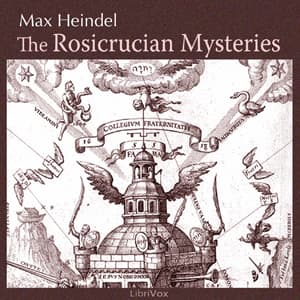

Look, I'm going to be honest with you: I did not expect to spend four hours of my life learning about invisible worlds, etheric bodies, and why the Rosicrucians think your desire body is literally made of a different substance than your physical one. And yet. Here we are.
I picked this up during one of those weird 2AM insomnia spirals where you've already fixed the production issue, your brain won't stop running, and somehow "early 20th century Christian occult philosophy" sounds like exactly the right vibe. Spoiler: it kind of was?
When Your Distributed Systems Knowledge Meets Metaphysical Architecture
So Max Heindel, writing in 1911, basically built a cosmological system that - and I say this with genuine surprise - reads like someone trying to architect a multi-layered distributed system for the universe. He describes seven "worlds" that interpenetrate each other, each with subdivisions, and the human being as an entity that has components operating across multiple layers simultaneously. My engineer brain kept mapping it: the dense physical body is your hardware, the vital body is your OS, the desire body is your application layer, and the mind is... I don't know, your orchestration framework?
The thing is, Heindel is dead serious about all of this, and the book is structured more like a textbook than a spiritual memoir. He walks through the Rosicrucian model of the cosmos, the nature of the soul, the process of death and rebirth, and how spiritual development supposedly works. There's a whole section on the "visible and invisible worlds" that gets surprisingly granular - he's not hand-waving, he's building a taxonomy. Whether you buy any of it is a separate question entirely, but as an intellectual exercise in early 20th century esoteric thought? Genuinely interesting.
Where it lost me: the book assumes you're approaching this as a seeker, not a skeptic. There's no "here's why you should believe this" - it's pure "here's how it works." If you're looking for a historical or anthropological take on Rosicrucianism, this isn't it. This is the primary source material, unfiltered. Think of it as reading the original RFC for a protocol you're curious about rather than a blog post explaining why it matters.
KirksVoice: The LibriVox Variable
Okay, so this is a LibriVox recording, which means volunteer narrator, and you need to calibrate your expectations accordingly. KirksVoice (Kirk Ziegler) delivers a clear, steady reading that honestly works pretty well for this type of material. The narration is straightforward - no dramatic flourishes, no character voices needed (this isn't fiction), just a guy reading philosophy to you in a measured pace.
Here's the catch that multiple listeners flagged: the first chapter is noticeably rougher than the rest. Once you get past that initial section, the narration settles into a professional-enough groove. It's not Ray Porter (nobody is Ray Porter), but for a free audiobook of a 1911 occult text, the production is clean and the reading is earnest. No weird background hums, no page-turning sounds, no dog barking in chapter 7. That's honestly a win for LibriVox.
At four hours, this is a short listen. I bumped it to 1.5x and finished it across two commutes plus some of that insomnia night. The pacing is naturally slow because Heindel writes in that meticulous early-1900s style where every concept gets three paragraphs of setup, so the speed bump helps.
Who This Is Actually For (Be Honest With Yourself)
Perfect for: anyone genuinely curious about Western esoteric traditions and willing to engage with the source material on its own terms. If you've read stuff on Theosophy, Rudolf Steiner, or Golden Dawn-adjacent philosophy and want to understand the Rosicrucian branch, this is your primer. Also decent for history-of-ideas nerds who want to understand what early 20th century mysticism actually looked like before it got filtered through a hundred layers of New Age repackaging.
Skip for: anyone expecting scientific rigor, a compelling narrative structure, or production values above "competent volunteer." If you picked this up thinking "Science & Technology" meant actual science - nope. This is firmly in the metaphysics-as-cosmology lane.
The ROI on this audiobook is... complicated. It's free (LibriVox), it's short, and it gave me a genuinely interesting framework to think about - even if I don't believe a word of the metaphysics. Sometimes the value isn't in agreeing with a book but in understanding how someone else modeled reality. Heindel built a complete system. That same fascination with how people build mental frameworks around complex systems - even when the conclusions are contested - is what made Sports Gene such a compelling listen for me: different domain entirely, but that same drive to explain human potential through a rigorous taxonomic lens. Wrong? Probably. But architecturally kind of impressive for 1911.
Commute Verdict: Background Processing Only
TL;DR: This is not a 6AM-zombie-train book. The concepts are dense enough that you need at least 60% of your brain online, and there's no narrative momentum to carry you through the fog. I'd save it for a focused walk or a quiet evening. It's the kind of listen where you'll zone out for ten minutes, realize you missed the entire explanation of the World of Life Spirit, and have to rewind. Ask me how I know.





![Steve Jobs [unabridged audiobook] audiobook cover](/_next/image?url=https%3A%2F%2Fcovers.audiobooks.com%2Fimages%2Fcovers%2Ffull%2F9788499923406.jpg&w=1920&q=75)