
So here's the thing — I'd seen some listeners call this "very well narrated" and others say they literally couldn't finish because the narrator had "no expression whatsoever." That kind of split? That's catnip for me. I had to hear it for myself.
I pulled this up on a slow Saturday afternoon at the library, headphones in, shelving returns in the quiet corner of our Oregon branch where the fluorescent light flickers just enough to set a mood. A parish priest solving a murder in small-town America? In a book written by a husband-and-wife team where the husband also narrates? There's something charmingly homegrown about that setup, and I wanted to give it a fair shake.
A Priest With a Badge (Sort Of)
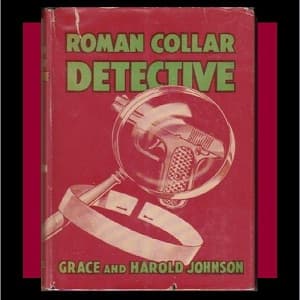
The premise is classic mid-century mystery fare: a gunshot, a dead prominent citizen, local politics tangled up with the crime, and an amateur sleuth who happens to wear a Roman collar. The "priest detective" subgenre has legs — think Father Brown, think Cadfael — and Roman Collar Detective is clearly playing in that tradition. The tight, efficient whodunit structure reminded me of what Graduation Day does well — keeping the runtime lean and letting the mystery mechanics carry the weight. Grace F. Johnson keeps the plot tight at just over four hours, which works in the book's favor. There's no bloat here. The political intrigue is kept local and personal, which gives the whole thing a cozy-mystery-meets-noir quality. The problem is that "cozy" and "noir" are fighting each other the entire time, and neither quite wins.
The mystery itself follows a pretty conventional whodunit structure — suspects are introduced, motives are layered in, and the priest uses his unique position (trusted by everyone, privy to confessions and community gossip) to piece things together. It's not going to blow your mind with twists, but there's a comfortable efficiency to how the plot moves. If you've read enough golden-age detective fiction, you'll spot the killer before the collar does. But that's okay — sometimes the fun is in the ride, not the destination.
Harold Stanley Johnson and the Art of Not Quite Committing
Let me be blunt: the narrator does not commit. And you know how I feel about that.
Harold Stanley Johnson — who co-wrote the source material with his wife — reads this book. And "reads" is the operative word. For the first stretch, it genuinely sounds like someone reading aloud from a manuscript at a kitchen table. Flat. Measured. Almost academic. There's a murder in the opening pages and the delivery treats it with the same energy as a grocery list. I kept waiting for the switch to flip, for some urgency to kick in.
And here's the thing — it does get better. Somewhere around the midpoint, Johnson settles into a rhythm. He finds a groove with the priest's voice that's calm and observant without being totally lifeless. It's not a performance I'd call dynamic, but it becomes... listenable. You adjust. Your brain recalibrates expectations. But that initial weak stretch is a real barrier, and I understand why some people bounced off this hard.
There's essentially no character differentiation through voice. The priest sounds like the suspects who sound like the politicians who sound like the witnesses. In a mystery — a genre that lives and dies on dialogue, on interrogation, on the tension between what people say and how they say it — that's a significant problem. You're doing extra cognitive work to track who's speaking, and at four hours, that shouldn't be necessary.
One listener asked, "Are there no English readers?" which I think is less about accent and more about frustration with the flat delivery. Johnson isn't hard to understand. He's just not giving you anything to hold onto emotionally.
Who's Going to Enjoy This (And Who Should Keep Walking)
If you're a completionist for priest-detective fiction, or you have a soft spot for obscure mid-century mystery novels, this has a certain charm. It's short, it's clean, it's inoffensive. The kind of thing you put on while doing dishes and half-follow, letting the whodunit structure carry you.
But if you need your narrator to act — and I do, I really do — this is going to test your patience. Good horror requires good acting. Good mystery requires it too. The ones who understand this create magic. Harold Stanley Johnson creates background noise for the first half, then upgrades to adequate. That's not enough for me.
(Shirley — my cat, not Jackson — sat on my lap through the whole thing and didn't flinch once. Fair assessment, honestly.)
Shelving This One in the Back Stacks
There's a version of this audiobook with a narrator who leans into the noir atmosphere, who gives the priest warmth and the suspects menace, that could be genuinely fun. This isn't that version. The story underneath is a perfectly serviceable small-town murder mystery with a charming premise. But the audio experience? It's the equivalent of reading a mystery novel under bad lighting — you can do it, but why would you when better options exist?









