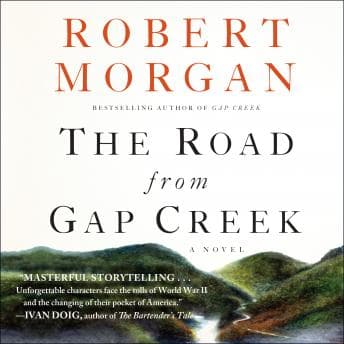

Denise and I were doing our Saturday lakefront walk - late October, the kind of cold that makes your ears sting but you keep going because the light on the water is too good to waste - and I had this playing through one earbud while she had her true crime podcast in the other. Married 22 years, folks. Romance is alive.
But here's the thing: I kept pulling out my earbud to tell her things. "Annie just described her daddy's hands as looking like they were carved from cedar root." "She's talking about her brother going off to war like she's reporting the weather, and it's devastating." Denise finally told me to just tell her about it when we got home. I did. It took forty minutes.
Morgan Writes Like Soil Remembers Rain
Robert Morgan does something I spend entire class periods trying to explain to juniors who think Hemingway was just bad at adjectives. He writes plain. Deceptively, stubbornly plain. The sentences in Road from Gap Creek are short and declarative and rooted in physical detail - wood smoke, creek water, the weight of a feed sack - and somehow they carry the emotional tonnage of a Faulkner paragraph without any of the syntactic gymnastics. Annie Richards narrates her family's passage through the Depression and World War II the way real people from that era actually talked about hardship: matter-of-factly, with the grief tucked underneath like a quilt folded at the foot of a bed.
This is why we still read the classics. Because Morgan is writing in a tradition - Willa Cather, Wendell Berry, the Appalachian voices that American literature keeps trying to forget - and he's doing it without a shred of condescension. Annie doesn't explain her world to outsiders. She just lives in it, and you either keep up or you don't.
Now. Some honest notes. Annie does repeat herself. She'll circle back to the same observation about a character or a worry about money, and in print you might skim past it. In audio, at 11 hours and 19 minutes, those repetitions land harder. By hour seven I noticed a pattern: Annie would describe a scene, reflect on it, then essentially restate her reflection in slightly different words. It's realistic - people do this, especially people processing hard times - but it occasionally made me feel like the book was walking in place when it should've been moving forward.
Emma Galvin Earns That Audie Award
Let me talk about Emma Galvin, because she's doing something genuinely difficult here and making it look easy. The narrator understands that pause is punctuation. She reads Annie with a folksy warmth that never - and I want to emphasize this - never tips into hillbilly parody. That's a tightrope. I've listened to audiobooks set in the rural South where the narrator sounds like they're auditioning for a dinner theater production of Deliverance. Galvin treats Annie's voice with the same respect Morgan gives her on the page.
Her Annie sounds like a woman who's lived through things and come out the other side not hardened exactly, but weathered. There's a sincerity in Galvin's delivery that made me trust Annie even when Annie was being unreliable about her own emotions - saying she was fine while describing something clearly devastating. That gap between what Annie says and how Galvin says it? That's interpretation. That's performance art. I've encountered that same kind of gap between surface calm and emotional undercurrent in Anxious People — completely different setting, modern Sweden instead of Appalachia, but Backman does that thing where characters insist they're fine while the whole narrative is quietly screaming otherwise.
I do understand the listeners who wished Jill Hill had narrated this one, since she voiced the original Gap Creek. There's something to be said for continuity, and if you've got Hill's voice imprinted on Julie Richards, hearing a different voice for the family can feel like showing up to Thanksgiving at the wrong house. But Galvin isn't trying to be Hill. She's building Annie as her own person, distinct from her mother Julie, and that actually serves the book's purpose - this is a generational story, and the shift in voice mirrors the shift in perspective.
Who This Is Really For
If you loved Gap Creek, this is its spiritual successor - though "sequel" undersells what Morgan is doing. It's less a continuation and more a widening of the lens. You watched one marriage survive its first year; now you're watching that marriage's children try to build lives in a world that keeps pulling the floor out from under them.
If you've never read Morgan, you could start here, but I'd say go back to Gap Creek first. Not because you'll be lost - Annie tells you everything you need to know - but because the emotional payoff of watching Julie and Hank through their daughter's eyes hits different when you already know what they went through.
My students would hate this. Too slow, they'd say. Nothing happens. And I'd tell them what I always tell them: everything happens. You're just not paying attention to the right things. (They'd roll their eyes. I'd assign it anyway.)
Worth Pausing the Faculty Meeting For
This is a quiet book. It won't grab you by the collar. It'll sit down next to you on a porch and start talking, and three hours later you'll realize you haven't moved. Morgan's prose deserves to be savored, and Galvin gives it exactly the pace it needs. I listened at 1.0x, obviously, because I'm not a monster. At 11 hours, it's a commitment, but it's the kind of commitment that rewards patience - like a long walk along a lake with someone you love, one earbud in, the cold stinging your ears, the light on the water doing something you can't quite describe but don't want to miss.