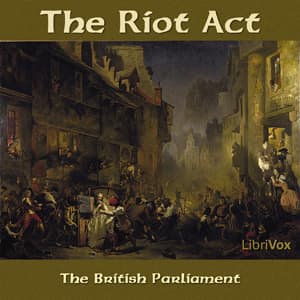

How many phrases do you use every day without knowing where they come from? "Reading the riot act" — I've said it to my third-period class at least twice a week for twenty years. Turns out there's an actual Riot Act. Written down, codified, passed by Parliament, and for 258 years it carried the literal threat of death. Twenty minutes. That's all this audiobook is. Twenty minutes, and it completely reframed a phrase I'd been using as a joke about cell phones in my classroom.
A Law That Meant Business — and Death
Let me set the scene for you historically, because context is everything. It's 1714. George I has just taken the throne, and Britain is a mess. Jacobite sympathizers, religious tensions, social unrest — the preamble to this Act reads like a government pressing the panic button. What Parliament produced was brutally simple: if twelve or more people gathered unlawfully and refused to disperse within one hour of hearing the official proclamation read aloud, they could be killed. And the officers who did the killing? Immune from prosecution.
That's it. That's the law. No appeals process, no gradations of punishment. Disperse or die.
What struck me listening to this — and I was listening during a particularly mind-numbing stretch of grading sophomore essays on The Great Gatsby at 11:30 PM — is how the language itself functions as a weapon. The proclamation that had to be read aloud before force could be used is included verbatim, and it's chilling in its bureaucratic formality. It essentially says: "We are now legally permitted to harm you. Your hour starts now." The legalistic precision of the wording isn't accidental. Every clause is designed to close a loophole, to make sure no rioter could argue they weren't warned. This is legislation as threat, and hearing it spoken aloud rather than reading it on a page — that changes how it lands.
David Barnes and the Strange Art of Narrating Parliament
Here's the thing about narrating a legal statute: there's almost no room for interpretation, and that's what makes it fascinating from an audiobook perspective. David Barnes reads this straight. No dramatic flair, no attempt to turn 18th-century legalese into theater. And honestly? That's the right call. The text doesn't need a performance — it needs clarity. Barnes delivers the archaic sentence structures without stumbling, which is harder than it sounds when you're dealing with phrases like "being unlawfully, riotously and tumultuously assembled together" that run on for half a page without a period.
But I'll be honest — at twenty minutes, there's not enough material here to truly evaluate a narrator's range. Barnes is competent and clear. He treats the text with the seriousness it deserves. That's about all I can say, and I'd rather tell you that than invent praise I can't back up.
What's Really Being Said Here
Let's talk about what the author is really saying. And yes, I realize the "author" here is the British Parliament, which makes this the most committee-written text I've ever reviewed on this site. But strip away the procedural language and you're left with something genuinely unsettling: a government granting itself the right to kill its citizens for the crime of gathering in a group and being angry.
The Riot Act wasn't repealed in Britain until 1973. Let that sit for a second. This law — the one that literally authorized lethal force against crowds — was on the books during the civil rights era, during the Vietnam War protests, during the Summer of Love. It had "fallen into disuse," sure, but it was still there. And a version remains in force in Canada today.
I teach literature, not law. But the best primary source documents read like literature. They tell you what a society feared, what it valued, who it was willing to sacrifice. Sean Carroll's Big Picture does something similar on a cosmic scale — uses the language of science to ask the same kind of uncomfortable questions about meaning and what we're actually willing to believe. This twenty-minute listen tells you more about the relationship between power and protest in Georgian England than most history textbooks manage in a chapter.
My students would hate this. I love it.
The Assignment
This is not a book you "enjoy." It's a primary source document, and it's twenty minutes long, and it's free on LibriVox. If you're a history nerd, a law student, someone who loves etymology, or just a person who wants to know what you're actually referencing when you tell your kids to clean their room "or else" — this is worth your time. If you want narrative, character development, or anything resembling a story, this isn't that. It's a legal text. It does exactly what it says on the tin.
Worth pausing the faculty meeting for? Absolutely. Principal Martinez's budget presentation was forty-five minutes longer and considerably less interesting than this.