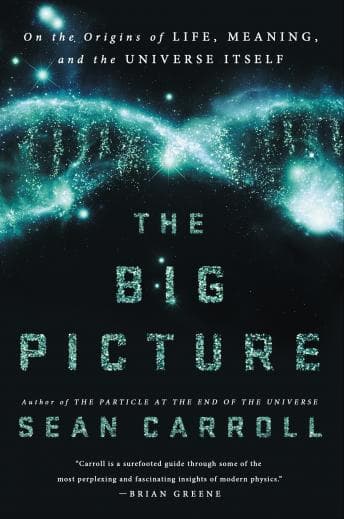

"We are small but we are not insignificant."
That line hit me somewhere around hour fourteen, while I was stirring a pot of dal that my mother would have criticized for being too watery. Sean Carroll had just spent the better part of seventeen hours systematically dismantling every comforting illusion about the universe—no cosmic purpose, no grand designer, no special place for humanity in the void—and then he lands this. The research actually shows that humans are remarkably good at finding meaning even when told there is none. Carroll seems to understand this about us.
A Physicist Plays Therapist to the Existentially Anxious
What makes this book compelling is that Carroll isn't just explaining physics. He's doing something far more ambitious: constructing an entire philosophical framework he calls "poetic naturalism." The idea is that you can accept the cold, mechanistic reality of particles and forces while still finding genuine meaning in human experience. It's the kind of cognitive flexibility that Brainstorm explores in developing brains—holding two seemingly contradictory truths at once. Both are true. Neither cancels the other.
This is, frankly, a fascinating case study in how scientists communicate worldviews. Carroll structures the book in short chapters—bite-sized enough that you don't drown in quantum mechanics, but substantial enough that you're actually learning something. He moves from the cosmic scale (entropy, the arrow of time, the origins of the universe) down to the human scale (consciousness, free will, why we care about anything at all).
The epilogue's discussion of the Core Theory and Feynman's path integral formulation is genuinely thrilling if you're into that sort of thing. (I am. My therapist would have thoughts about why I find mathematical elegance emotionally soothing, but here we are.)
When Your Professor Sounds Like He's Asking You a Question
Here's where I have to be honest about the listening experience. Carroll narrates his own book, which means you're getting the ideas straight from the source. There's something valuable about that—you can hear his enthusiasm, his genuine curiosity, the way he pauses when he's about to say something he finds particularly beautiful.
But. And this is a significant but.
He reads in upspeak. Every assertion sounds like a question? Like he's constantly checking if you're following? It took me about three hours to stop noticing, and then another hour before it started bothering me again. Some listeners apparently found his use of gender-neutral pronouns distracting—I found myself asking: why does this bother people more than the fundamental meaninglessness of existence? Priorities, folks.
The narration is clear and friendly, like sitting in a really good lecture hall with a professor who actually wants you to understand. But at seventeen hours, that lecture hall feeling becomes... a lot. This is not background listening. This is "pause and think about what he just said" listening. I had to restart entire chapters because I'd zoned out while chopping onions and missed something crucial about quantum field theory.
The God Question (Because Someone Will Ask)
Carroll doesn't hedge. He's an atheist, and he explains why naturalism doesn't require a creator. Some listeners bristled at this—one reviewer mentioned being annoyed by his "utter rejection of a Creator." Psychologically, this doesn't track as a fair criticism of the book itself. Carroll isn't dismissive or cruel about it. He's just... honest about where the evidence points, according to his framework.
If you're looking for a book that will confirm your existing beliefs about a designed universe, this isn't it. If you're looking for a book that takes the question seriously and explains why one very smart person arrived at his particular answer, this is excellent.
Who This Is Really For (And Who Should Run)
This book requires something from you. It's not a casual listen. You need to be willing to sit with uncomfortable ideas, to follow chains of reasoning that span multiple chapters, to accept that the universe doesn't owe you meaning and then figure out what to do with that information.
Perfect for: philosophy nerds, science enthusiasts who want to understand how physics connects to human experience, anyone having an existential crisis who prefers data to platitudes.
Skip if: you want light listening, you're easily frustrated by upspeak, or you're looking for spiritual comfort rather than intellectual rigor.
I'd recommend 1.25x speed if you're already familiar with basic physics concepts. Otherwise, stick with normal speed and don't be afraid to rewind.
My Prescription
Listening to Carroll is like having a really good conversation with someone smarter than you who doesn't make you feel stupid about it. The protagonist here—Carroll himself, really—exhibits a classic pattern of the scientist-philosopher: someone who has stared into the void and come back not with despair, but with a strange kind of joy.
The dal turned out fine, by the way. A little watery, but meaningful to me.









![Steve Jobs [unabridged audiobook] audiobook cover](/_next/image?url=https%3A%2F%2Fcovers.audiobooks.com%2Fimages%2Fcovers%2Ffull%2F9788499923406.jpg&w=1920&q=75)