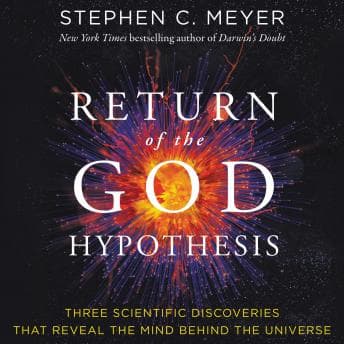

So here's the thing nobody wants to say about this book: it's basically an intelligent design argument wearing a really nice lab coat. And I mean a really nice lab coat — Cambridge PhD, former geophysicist, the whole package. I went in expecting a rigorous philosophy-of-science deep dive and got... something more complicated than that.
I started this one during a week where Kevin was out of town and I was filling the silence with audiobooks instead of, you know, dealing with my feelings like a normal person. The last time I committed to something emotionally avoidant at that scale, it was Between the World and Me — a much shorter listen, but one that also left me staring out the train window feeling like my assumptions had been quietly rearranged. Almost 19 hours is a serious commitment. That's roughly 8 round-trip Caltrain commutes at my usual 1.5x speed, plus a few late-night coding sessions where I let it run while watching dashboards.
The Architecture of the Argument
Meyer structures this around three pillars: the fine-tuning of the universe's physical constants, the origin of biological information (DNA as code — and yes, as someone who literally debugs code for a living, I have thoughts), and the Big Bang's implications for a cosmic beginning. The fine-tuning stuff is genuinely interesting. When he walks through the specific constants — the cosmological constant, the ratio of electromagnetic force to gravitational force — and how absurdly narrow the life-permitting ranges are, my engineering brain perked up. Those numbers are wild. The probability spaces he describes are the kind of thing that makes you stare out the train window at 6:47 AM and question reality.
But here's where my BS detector started pinging: Meyer frames this as an "inference to the best explanation" — a legit philosophy-of-science method — then systematically dismisses multiverse theory, panspermia, and various materialist alternatives in ways that felt... selective. He spends chapters thoroughly steel-manning positions before dismantling them, which I respect structurally. But the dismantling sometimes relies on "we don't have evidence for X, therefore God" logic that wouldn't pass code review. Absence of evidence for multiverses isn't evidence of absence. That's Logic 101.
The biology sections retread a lot of ground from his earlier books (Signature in the Cell, Darwin's Doubt). If you've read those, you're getting a greatest-hits compilation with updated framing. The new contribution here is really the leap from "some intelligent designer" to "personal God," and honestly, that's the weakest link in the chain. He goes from rigorous (if debatable) scientific analysis to theological conclusion pretty quickly in the final hours.
Timothy Andrés Pabon Does the Heavy Lifting
Pabon's narration is genuinely solid for this kind of dense material. Clear enunciation, measured pacing — he treats the technical passages with the kind of careful cadence that keeps you from zoning out when Meyer is walking through Bayesian probability arguments. (And there are a lot of probability arguments.) He doesn't try to make it dramatic or exciting. He reads it like a well-prepared lecture, which is exactly the right call for a book that's essentially 19 hours of philosophical argumentation with scientific footnotes.
That said — and this is a commute-worthiness issue — there are stretches in the middle third where the argumentation gets recursive. Meyer will make a point, address a counterargument, address a counter-counterargument, and then restate the original point. It's thorough. It's also the kind of thing where you zone out for 90 seconds on a crowded train and suddenly you're three layers deep in a nested argument and have no idea which branch you're on. It's like debugging someone else's recursion without stack traces.
I bumped to 1.25x for most of the technical sections and honestly wouldn't go higher. This isn't a business book you can blast at 1.75x — the logical chains are too interconnected.
Who This Is Actually For (and Who It Isn't)
If you're already sympathetic to intelligent design and want a sophisticated, well-sourced version of the argument? This is probably the best audiobook-length treatment out there. Meyer is leagues ahead of your typical apologetics author in terms of scientific literacy.
If you're a hard materialist looking for something to argue with? Honestly, still worth your time. He engages seriously with the strongest atheist positions — Dawkins, Hawking, Susskind — and even when I disagreed with his conclusions, the exercise of following his reasoning sharpened my own thinking about cosmological fine-tuning.
If you want settled science? This ain't it. Meyer is affiliated with the Discovery Institute, which is basically the flagship org for intelligent design advocacy. That doesn't automatically invalidate his arguments, but it's context you should have. He's making a case, not reporting consensus.
Skip if: you want something you can half-listen to. This requires active engagement or you'll miss the logical connective tissue.
The Commit Message
TL;DR: Worth your commute if you want a serious (if ultimately unconvincing to me) philosophical argument for theism dressed in scientific rigor. The ROI on this audiobook is high for intellectual exercise, lower for settled answers. I came away not believing in God but with a better understanding of why smart people find the fine-tuning argument so sticky. And I respect that.
I finished this in about 8 commutes and two insomniac coding nights. Would I listen again? No. But I'm glad I did it once. It's the kind of book that makes you think even when — especially when — you disagree.