
Okay, we need to talk about the word "doppelganger."
Because if I have to hear a professional narrator—someone who literally gets paid to talk—butcher it one more time, I'm going to start debugging production code without coffee. Seriously. It happens in this book, and it pulled me right out of my data-trance every single time. It's the audio equivalent of a missing semicolon that crashes the whole build.
(Yes, I know that's petty. But when you're stuck on a stalled train at 7 AM, petty is all you have.)
That aside? This book is actually kind of brilliant.
The "Freakonomics" of Your Browser History
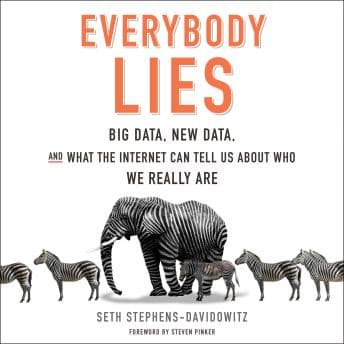
Here's the premise: We lie to everyone. We lie to our friends, our spouses, and definitely to those surveys that ask how much we exercise. But we don't lie to the Google search bar.
Stephens-Davidowitz basically scraped the collective id of the internet to show us who we really are, and wow, we are a mess. As someone who spends her day job looking at system logs to find out why things broke, this spoke to me. People are just buggy distributed systems.
He covers everything—racism, sex, child abuse, stock markets. It's dark stuff, but treated with this cold, analytical lens that I honestly found refreshing. It's not preachy. It's just... data.
I listened to the section on "The Digital Truth Serum" while passing SFO, and let me tell you, looking around the train car at everyone on their phones hit differently. You start wondering what the guy in the Patagonia vest is actually searching for. (Hint: According to the book, it's probably not investment advice.)
Timothy Andrés Pabon's Delivery (And That One Glitch)
Pabon narrates this, and aside from the aforementioned "doppelganger" incident, he's actually solid.
He has this crisp, "business insider" tone that works perfectly for a book about big data. He doesn't try to act out the statistics (thank god). He just delivers the payload.
I cranked him up to 1.75x speed. At that pace, he sounds like a really smart product manager giving you the rundown before a launch. It fits. The production is clean—no weird mouth noises, no background hiss. Just pure signal.
But be warned: The book is short. Like, barely 8 hours. If you're aggressive with your playback speed, you'll finish this in two round-trip commutes.
Who's This For?
If you're already deep in tech or data science, some of this will feel familiar—you know the vibe if you've read Nate Silver or Freakonomics. Give and Take has that same data-driven approach to human behavior, though it focuses more on workplace dynamics than search history confessions. Skip this if you want actionable frameworks; it's more "here's what the data shows" than "here's what to do about it."
But if you want specific examples that stick? The way he correlates search terms with future behaviors is fascinating. It's the kind of book that gives you three or four "Did you know?" facts to drop at dinner parties to make everyone slightly uncomfortable. Perfect for commuters, data nerds, or anyone who suspects humanity is weirder than it lets on.
Closing the Loop
Bottom line: It's efficient, it's data-heavy, and it confirms that humanity is weird as hell.
Just try to ignore the pronunciation issues. Or turn it into a drinking game. (Actually, don't do that on the train. Caltrain security frowns on it.)








![Steve Jobs [unabridged audiobook] audiobook cover](/_next/image?url=https%3A%2F%2Fcovers.audiobooks.com%2Fimages%2Fcovers%2Ffull%2F9788499923406.jpg&w=1920&q=75)