
What happens when a country's darkest wartime secrets refuse to stay buried - and the people who kept them start turning up dead?
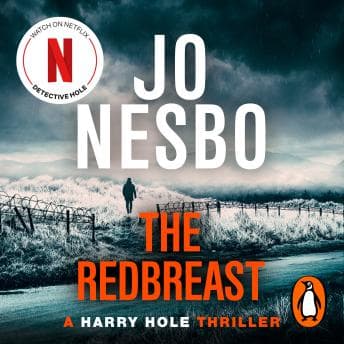
I was shelving books in the 900s section on a Tuesday evening - the library was empty, that particular kind of quiet where the fluorescent lights seem too loud - when I realized I'd been standing in the same spot for twenty minutes, one hand frozen on a spine, the other gripping my phone like it owed me money. Sean Barrett had just walked me through a scene where Harry Hole connects a rare Märklin rifle to a thread of Norwegian Nazi collaboration that most people would rather forget, and I genuinely forgot where I was.
That's the thing about The Redbreast. It got me.
Norway's WWII Ghosts Won't Stay Dead
Let me be upfront: this isn't horror. But Jo Nesbø understands something that the best horror writers understand - that real dread comes from history, from the things we collectively agreed not to talk about. Norway's role in WWII, the volunteers who fought on the Eastern Front for the Germans, the quiet accommodations made and never accounted for - Nesbø digs into all of it with the patience of someone who knows the payoff is worth the slow burn. And it is a slow burn. The book toggles between present-day Oslo and the frozen battlefields of the 1940s, building parallel narratives that feel like they're moving at completely different speeds until they slam together in ways that made me actually say "oh" out loud on my couch at midnight. Shirley (my cat) was unimpressed. I was riveted.
Some listeners have called the plot predictable. I'd push back on that - partially. The broad strokes of who the killer is? Sure, if you're genre-savvy, you might clock it early. But Nesbø isn't really playing a whodunit game here. He's playing a why game, and the why is where the book earns its nearly fifteen hours. The intertwining of characters across decades, the way a choice made in a frozen trench in 1943 metastasizes into murder in modern Oslo - that's where the craft lives. The web of it is genuinely impressive, even if the timeline jumps and the sheer volume of characters demand your full attention. This is not a multitask audiobook. You zone out for five minutes and suddenly you're lost in a subplot about South African arms dealers wondering how you got there.
Sean Barrett Carries a Heavy Load (Mostly)
Barrett's performance here is solid and committed in ways that matter. His Harry Hole has this worn-down, slightly combative quality - you hear the hangover in his voice, the stubbornness that keeps him digging when anyone sensible would stop. And when the narrative shifts to the WWII sequences, Barrett drops into a register that's quieter, more measured, almost reverent. His German accents are surprisingly good - not cartoonish, not overdone, just enough to signal the shift in setting and stakes.
Where it gets a little wobbly: the Norwegian names. Look, I get it - Norwegian pronunciation is a minefield for English-speaking narrators, and Barrett occasionally lands on different versions of the same name within the same chapter. "Hole" alone seems to have three pronunciations across the book. It's not a dealbreaker, but once you notice it, you keep noticing it. It's the kind of thing that pulls you out of the story for a second before Barrett's steady command of the narrative pulls you back in.
The narrator commits. That's rare. Especially across fourteen-plus hours of a book this dense, with this many characters and this many tonal shifts. He doesn't phone in the quiet scenes. He doesn't overplay the violent ones. There's a restraint to his performance that suits Nesbø's writing - which is itself restrained in a way that makes the moments of violence hit harder.
Who Needs This (And Who Should Probably Pass)
If you want Nordic noir that actually earns the "noir" label - the moral ambiguity, the institutional rot, the detective who's his own worst enemy - this is your book. Certain Prey scratches some of that same institutional-rot itch if you need something to bridge the gap before the next Hole novel lands. If you're interested in WWII history beyond the usual narratives (the sections on Norwegian volunteers fighting for Germany are genuinely eye-opening), even better.
But if you need a fast pace? If a book with multiple timelines, a dozen-plus named characters, and a willingness to spend time on political and historical context sounds exhausting? This might not be your listen. It demands focus. It rewards it, but it demands it.
And honestly? If you scare easily - not from supernatural horror, but from the horror of what ordinary people are capable of when ideology gets its hooks in - skip. If you don't? You need this.
The Case File Stays Open
My podcast listeners are going to love this one, even though it's outside our usual lane. Because The Redbreast understands something fundamental: the scariest monsters aren't supernatural. They're the ones who wore uniforms, made choices they can't take back, and spent decades pretending they didn't. Nesbø gets that. Barrett delivers it. The Norwegian name thing is a minor irritant in what is otherwise a very strong listen. I'm already queuing up the next Harry Hole book, and I'm going to listen in the dark. Because that's how stories about buried sins are meant to be consumed.