
Denise and I were doing our Saturday lakefront walk — the one where we pretend we're exercising but really we're just shuffling along the shore arguing about what to have for dinner — when Enzo the dog started narrating his own death.
That's how this book opens. A dying dog, reflecting on his life, telling you straight away that he believes he'll be reincarnated as a human. And I'm standing there on the path near Montrose Harbor with my earbuds in, watching actual dogs chase each other through the grass, thinking: well, Garth Stein, you got me.
A Dog Who Watches Racing and Thinks Like Hemingway
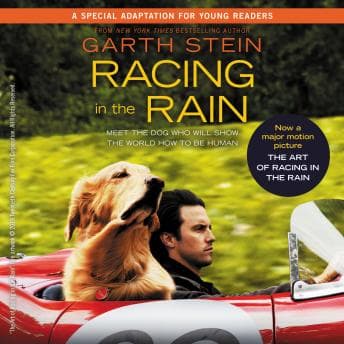
Let's talk about what Stein is really doing here. This is a young readers' adaptation of his adult novel The Art of Racing in the Rain, and it's told entirely from Enzo's perspective — a golden retriever mix who learns about the world through television and through watching his owner Denny, a wannabe race car driver, navigate custody battles, grief, and the daily indignities of being a decent man in hard circumstances.
The conceit works better than it has any right to. Enzo isn't anthropomorphized into some Disney sidekick. He's a dog who wishes he were human, who understands more than he can express, who's trapped by his lack of thumbs and vocal cords. There's a real philosophical thread here — Enzo keeps circling back to racing metaphors, the idea that the car goes where your eyes go, that you have to drive through the rain rather than fight it. My students would probably roll their eyes at the metaphor. But the thing is, it lands. It lands because Enzo believes it so completely.
The young readers' version trims some of the adult novel's darker edges — the custody fight is still there but softened, certain betrayals feel less visceral. If you've read the original, this is like watching the PG cut of a PG-13 movie. You lose some texture. But for what it is — a 5-hour-43-minute listen aimed at families — it carries surprising emotional weight.
Henry Leyva Makes You Forget You're Listening to a Human
Henry Leyva narrates this, and here's what I want to say about his performance: he doesn't try to be a dog. That would've been a disaster. Instead, he plays Enzo as someone earnest and slightly outside the world he's describing — like a foreign exchange student who understands everything but can't quite participate. His tone for Enzo is warm, a little wistful, occasionally frustrated in this very specific way that captures what it might actually feel like to understand a conversation you can't join.
The character differentiation is subtle — he doesn't do big cartoon voices for Denny or Zoë. It's more about energy shifts. Denny gets this tired patience. Zoë is lighter, quicker. The narrator understands that pause is punctuation, and there are moments — particularly in the early chapters and the ending — where Leyva just... lets the silence do the work. I was genuinely tearing up during the final stretch, which is embarrassing because I was by then sitting in my car in the school parking lot on a Monday morning trying to finish the last twenty minutes before first period. The last time a narrator got me that close to ugly-crying in a parking lot was Black Stallion — different animal, same gutpunch of a bond between creature and human.
(My students saw me wiping my eyes and assumed I'd gotten bad news. I told them I was fine. I did not tell them a fictional golden retriever had wrecked me.)
Where the Laps Get Repetitive
Here's where I have to be honest. The middle section drags. Stein leans hard on the racing-as-life metaphor, and by the third or fourth time Enzo connects a custody hearing to managing tire grip in wet conditions, you start to feel the pattern. The story doesn't have a traditional plot so much as a series of emotional situations — illness, legal battles, loneliness — filtered through a dog's limited but loving perspective. Some listeners will find that repetitive. They're not wrong.
And because this is the junior adaptation, some of the complexity that might've sustained those middle chapters in the adult version has been smoothed away. You can feel the absence. It's like reading an abridged Great Expectations — the bones are there, but you miss the muscle.
But that ending. The last thirty minutes pull everything together in a way that made me forgive the slow stretches entirely.
Who Should Leash Up for This One
If you're a dog person — and I mean the kind of dog person who looks at their mutt and genuinely wonders what they're thinking — this will hit you right in the chest. It's also a strong pick for parents looking to share an audiobook with kids around 8-12. The emotional content is real but not overwhelming. There's grief here, but it's handled with enough hope that it won't traumatize your fourth grader.
If you've already read the adult novel and want the fuller experience, this probably isn't your version. And if you need plot-driven momentum, Enzo's philosophical musings might test your patience.
Worth Pausing the Faculty Meeting For
This is a small, sincere book. It doesn't try to be more than it is — a dog's love letter to his human, wrapped in racing metaphors and the quiet conviction that loyalty is its own kind of heroism. The prose deserves to be savored, even in this trimmed-down form, and Leyva gives it the gentle, unhurried delivery it needs. At 1.0x. Obviously.
I've assigned worse books to my juniors. I might assign this one to myself again.