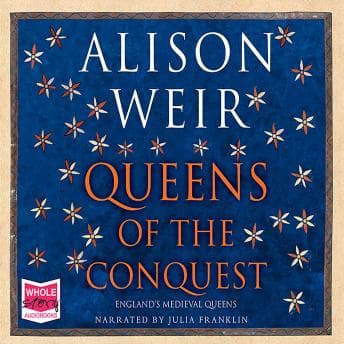

How much do we really know about the women who stood beside - and sometimes against - the men who shaped medieval England?
I've spent my career studying strategy and power dynamics, mostly in modern contexts. But there's something about medieval political maneuvering that hits different. No satellites, no encrypted comms, just raw ambition and the occasional siege. So when I saw Alison Weir tackling the Norman queens, I figured this was worth 17 hours of my commute time.
Let me cut to the chase: the content here is solid. Weir knows her stuff. She's done the homework, tracked down the primary sources, and built a picture of these five queens that strips away the fairy-tale nonsense. Matilda of Flanders wasn't just "William the Conqueror's wife" - she was a political operator in her own right. And the Empress Maud? That woman waged a civil war for her crown. These weren't damsels. They were players.
The Intelligence Briefing You Didn't Know You Needed
What Weir does well is treat these women as historical actors, not footnotes. She traces their influence on policy, their management of resources when their husbands were off campaigning, their strategic marriages and alliances. It's basically a crash course in soft power before anyone called it that.
The research is impressive without being academic in that dry, "I'm writing for tenure" way. Weir makes the material accessible. She'll explain why a particular alliance mattered, what the stakes were, who stood to gain. For anyone interested in how power actually worked in medieval England - not the Hollywood version - this delivers.
I found myself genuinely engaged during the sections on the Empress Maud. Here's a woman who was designated heir to the English throne, got sidelined when her father died, and then spent years fighting her cousin Stephen for what she believed was rightfully hers. The parallels to modern succession crises aren't hard to see. (And yes, I've seen enough real-world power transitions to appreciate how messy they get.)
Julia Franklin's Voice - Mixed Results
Now, here's where I have to be honest. Julia Franklin's narration is... functional. Her voice is clear, the pronunciation of medieval names and places seems accurate, and she maintains a consistent pace throughout. But there's a clunkiness to it that kept pulling me out of the narrative.
The pauses are the main issue. Mid-sentence stops that feel like editing hiccups rather than dramatic effect. It's not a dealbreaker - I've sat through worse briefings, trust me - but it does require some patience. I bumped it up to 1.25x pretty early on, and that helped smooth things out considerably.
Is it the worst narration I've heard? No. But it's not going to win any awards either. One reviewer I came across nailed it: "not one of the best performances I have listened to, but neither was it one of the worst." That's about right.
When the History Clicks
The real value here is Weir's ability to connect the dots across generations. You see how one queen's decisions rippled forward, how alliances made in one reign created problems - or opportunities - in the next. It's strategic thinking across decades, and that's the kind of long-game perspective that's increasingly rare. That same appreciation for how decisions compound over time is what makes Federalist Papers still relevant - different era, same fundamental questions about power and succession.
The book does get repetitive in spots. That's partly the nature of the material - medieval records are fragmentary, and Weir has to acknowledge the gaps while still building her narrative. Some sections feel like she's circling back to make sure you caught the significance. For 17 hours, that can drag.
But when it works, it works. The siege of Winchester, Maud's escape from Oxford Castle in a snowstorm - these moments come alive. You get a sense of what it actually cost these women to pursue power in a world that wasn't built for them.
Mission Debrief
Queue this up if: You're into medieval history, English monarchy, or just want to understand how power worked before gunpowder changed everything. Skip it if: You need a dynamic narrator or want something faster-paced - this is a 17-hour deep dive, not a thriller.
The narration issues are real but manageable, especially at increased speed. The content is strong, the research is solid, and Weir writes with enough personality to keep things moving.
Ranger sat through about half of this one before he started giving me that "can we listen to something with more action" look. Fair enough, buddy. But for those of us who appreciate a good strategic analysis - even one that's 900 years old - mission accomplished.
Just be prepared to work a little harder for it than you might with a more dynamic narrator. The intelligence is there. The delivery just needs some patience.






![Steve Jobs [unabridged audiobook] audiobook cover](/_next/image?url=https%3A%2F%2Fcovers.audiobooks.com%2Fimages%2Fcovers%2Ffull%2F9788499923406.jpg&w=1920&q=75)