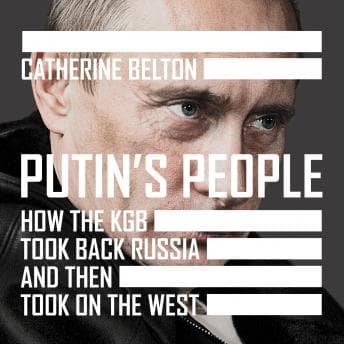
Couldn't sleep last Tuesday. Linda was out cold, Ranger was snoring at the foot of the bed, and my brain wouldn't shut off after a client briefing on Russian-linked cyber threats. So I did what any reasonable person does at 0200 — I started an eighteen-hour audiobook about the KGB. Smart move, Cooper.
Let me cut to the chase: Catherine Belton's Putin's People is the single best piece of open-source intelligence I've consumed on how post-Soviet Russia actually works. Not the sanitized diplomatic version. Not the conspiracy theory version. The version where you follow the money, the operatives, and the institutional memory of an intelligence service that never really died — it just changed business cards.
The KGB Never Closed, It Franchised
Belton's central argument is straightforward but devastating: the fall of the Soviet Union wasn't a defeat for KGB operatives — it was a leveraged buyout. She traces how KGB networks in the late '80s began stashing Communist Party funds abroad through front companies and cooperative banks, essentially building a war chest for a future they could see coming. Then she walks you through Putin's time in Dresden, his return to St. Petersburg, his alliance with the city's liberal mayor Sobchak, and how a mid-level intelligence officer with no obvious charisma managed to become the most powerful man in Russia.
The book is dense. I mean dense. We're talking 18 hours of shell companies, oligarch power plays, and enough Russian names to make your head spin. Belton doesn't hold your hand — she expects you to track the difference between Timchenko and Pugachev, between Bank Rossiya and Sogaz, and remember who flipped allegiance when. I had to rewind more than a few times, and I'm a guy who used to brief generals on threat networks.
But here's what separates this from a dozen other Russia books I've read: Belton actually got people to talk. Former KGB operatives, oligarchs who lost everything, Western bankers who enabled the whole machine. The interviews give the book a specificity that makes it credible even when the claims are extraordinary. When she describes how Yukos was dismantled — not just seized, but systematically asset-stripped through rigged bankruptcy proceedings — you can feel the machinery of the state grinding down anyone who stood in the way.
Bruce-Lockhart Behind the Mic
Dugald Bruce-Lockhart is a competent narrator, and his British delivery actually works well for material that reads like a le Carré novel (the comparison is inevitable and, for once, accurate). He handles the Russian names with reasonable consistency, which matters when you're juggling this many players.
But — and this is where it gets tricky — his delivery runs a little breathless at times. There's a theatrical urgency to his reading that works during the sections on Putin's rise or the Kremlin's campaign to reassert control over the oligarchs, but feels overdone during the more analytical passages about financial structures. An 18-hour book needs pacing variation, and Bruce-Lockhart doesn't always find it. By the sections covering the extension of Russian influence into Western politics and real estate markets, I was occasionally fighting the narrator's intensity when I needed a steadier hand.
I dropped to 1.0x for this one, which tells you something. At my usual 1.25x, I was missing connections between people and entities that matter later. This is not a book you half-listen to while checking email.
Where Belton Earns Her Reputation — And Where She Stretches
The strongest sections deal with the 1990s and early 2000s — the privatizations, the apartment bombings, the systematic takeover of NTV and other independent media. Belton's reporting here is rock solid, cross-referenced, and sourced from people who were in the room. Her account of how Putin's circle used the Yukos affair not just to destroy Khodorkovsky but to send a message to every businessman in Russia is chilling precisely because it's so methodical.
The later chapters — particularly around Trump and Western influence operations — feel thinner by comparison. Not wrong, necessarily, but more speculative, more reliant on inference rather than the direct testimony that powers the earlier material. Some listeners have called this section controversial, and I get it. Belton is connecting dots across continents and decades, and not every connection carries the same evidentiary weight. I've written enough intelligence assessments to know the difference between "confirmed" and "assessed with moderate confidence," and the final third of this book lives more in the latter category. Oddly enough, grappling with that evidentiary ambiguity reminded me of sitting with Introduction to The Philosophy of History — a book that wrestles hard with what it even means to make confident claims about human events, though I'll warn you that one didn't move me the way Belton does.
That said — the scope is staggering. From Dresden to London's Mayfair, from Cyprus shell companies to Manhattan real estate, Belton maps an influence network that should concern anyone who cares about institutional integrity in Western democracies. I've seen some of these patterns play out in my consulting work, and it's unsettling how much of what she describes tracks with what corporate security professionals are seeing on the ground.
Worth Your Time? Here's the Debrief
If you want to understand modern Russia — not the Twitter version, not the cable news version, but the actual power structure — this is your book. It demands attention, rewards patience, and will make you deeply uncomfortable about how much dirty money has already embedded itself in Western institutions.
Who should listen: anyone in security, policy, journalism, or international business. Anyone who wants to understand why things are the way they are right now.
Who should skip: if you need a fast-moving narrative or can't handle tracking dozens of Russian names across two decades of financial complexity, this will frustrate you. It's not a thriller. It's an autopsy of a democracy that never quite got born.
Ranger slept through most of it. But I didn't.







![Steve Jobs [unabridged audiobook] audiobook cover](/_next/image?url=https%3A%2F%2Fcovers.audiobooks.com%2Fimages%2Fcovers%2Ffull%2F9788499923406.jpg&w=1920&q=75)