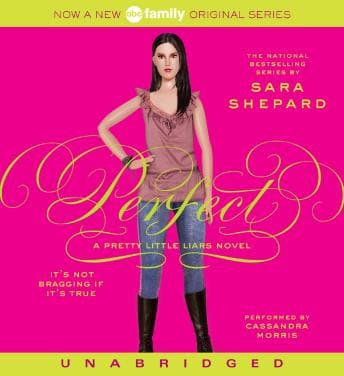

Sara Shepard's Perfect is basically a 7.5-hour psychology experiment in adolescent shame spirals, and I am here for it.
I was making chana masala on a Sunday evening — the kind of elaborate, slow-simmering project where you convince yourself you're being meditative but really you're just avoiding your inbox — when I started this third installment. And something about stirring spices while four teenage girls systematically destroy their own lives felt... appropriate? Like watching a controlled demolition from a safe distance.
Four Case Studies in Self-Sabotage
Here's what makes this series work as pop psychology, even if Shepard would probably not describe it that way: each of the four liars represents a distinct maladaptive coping pattern. Aria's forbidden relationship with her ex-teacher isn't just scandal for scandal's sake — the protagonist exhibits classic repetition compulsion, returning to the thing that burned her because the familiar pain is easier to sit with than the unknown. Hanna's social anxiety manifests in her desperate grip on friendship status, and the bulimia subplot (which the book handles with varying degrees of care) is textbook externalization of control issues. Emily's panic over a kiss? That's internalized shame meeting an environment that punishes authenticity. And Spencer — oh, Spencer — who can't stop taking what belongs to her sister? That's not greed. That's a kid who's been told her entire life she's second best, so she's testing whether anyone will finally stop her.
I found myself asking: why does "A" actually work as a threat? Not as a plot device — as a psychological mechanism. And the answer is pretty simple. These girls aren't afraid of being exposed for doing bad things. They're afraid of being seen. There's a difference. "A" weaponizes the gap between the Rosewood performance of perfection and the messy reality underneath. That gap is where all the tension lives.
Now. Is the character psychology groundbreaking literary fiction? No. Psychologically, some of it doesn't quite track — teenagers in this universe make decisions with the strategic calculation of chess grandmasters one minute and the impulse control of toddlers the next. But Shepard understands something real about how adolescent identity works: you build a self out of other people's expectations, and then you're trapped inside it.
Cassandra Morris and the Voice Question
Here's where I have to be honest about a split opinion. Cassandra Morris is an award-winning narrator — multiple Earphones Awards, Audie finalist, the whole résumé. And there's a reason for that. She's technically skilled, her pacing is solid, she knows how to handle dialogue-heavy scenes without losing the listener. For a book that jumps between four POVs with distinct problems and emotional registers, she keeps things organized enough that you always know whose chapter you're in.
But — and this is the thing I kept noticing while the cumin was burning (sorry, cumin) — her voice has a quality that's going to split listeners right down the middle. Some people find it slightly off-putting, a tonal choice that doesn't quite match the characters' ages or the Rosewood setting. I didn't hate it, but I noticed it, which in audiobook narration means something. By hour three, I'd adjusted. By hour five, I'd stopped thinking about it. But those first couple of hours? There was friction.
If you've watched the TV show and you're coming to this expecting that energy — recalibrate. The audiobook is a different animal. The show amplified the thriller elements; the book (and Morris's reading of it) leans more into the interior dread, the social anxiety, the constant looking-over-your-shoulder quality. I actually think the audiobook captures something the show couldn't: how much of this story happens inside these girls' heads.
Who This Is Really For (And Who Should Run)
This is a fantastic road trip or easy-listening audiobook. I mean that as a compliment. Not every listen needs to be a 40-hour epic fantasy that requires a spreadsheet. Perfect is propulsive, it's structured around constant small reveals, and it doesn't ask you to remember seventeen subplots from previous books — though reading the first two helps.
If you need realistic adult decision-making? Skip this. If a teacher-student affair subplot is a hard no for you — completely valid, and the book doesn't exactly interrogate the power dynamics the way I'd want — this isn't your book. If you're bothered by teen drinking, smoking, and general recklessness being presented without much consequence beyond plot mechanics, you might find yourself frustrated.
But if you're the kind of person who watches true crime docs and mutters "attachment theory" under your breath? This is a fascinating case study in how social environments manufacture secrets. Rosewood isn't just a setting. It's the pressure cooker.
My Therapist Would Have Thoughts About These Girls
Three books in, I'm invested. Not because these are the most psychologically sophisticated characters I've encountered — they're not. But because Shepard gets the engine right. People don't lie because they're bad. They lie because the truth would cost them the only identity they have. And "A" knows that. Which makes "A" less a villain and more a mirror. The same dynamic — an antagonist who functions more as a psychological pressure system than a straightforward bad guy — is actually what makes Rogue Lawyer worth a look, even if the setting couldn't be more different; Grisham's narrator is also trapped by the gap between who he performs and who he actually is.
I'll be listening to book four. Probably while making biryani. My mother would approve of at least one of those choices.